
See How Modeling and Simulation Is Used Across Industries
Multiphysics modeling and simulation drives innovation across industries and academia — as is evidenced by the many uses showcased in the technical papers and posters presented by engineers, researchers, and scientists at the COMSOL Conference each year.
Draw inspiration from the recent proceedings collected below, or, to find a specific presentation or filter by application area or conference year/location, use the Quick Search tool.
View the COMSOL Conference 2025 Collection

Wire Electric Discharge Machining (WEDM) is widely used technique for machining intricate geometries. It is a spark erosion, non contact machining process and this gives it an advantage in machining metals irrespective of their hardness [1]. Main process parameters of WEDM are peak ... Read More
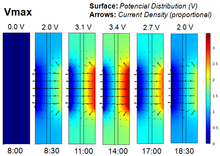
The production of hydrogen from renewable energy surplus is seen as a key strategy for energy storage. Centro Nacional del Hidrógeno works actively in this direction by considering a strategic line in order to achieve a sustainable energy future. Alkaline electrolysis is the main ... Read More
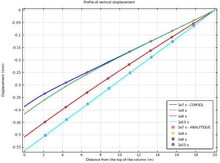
The long-term behaviour of the underground excavations is a social and economic challenge particularly in the contexts of post-mining or radioactive waste storage. Numerical modelings are currently used to understand and forecast the complex behaviour of rock mass around the underground ... Read More
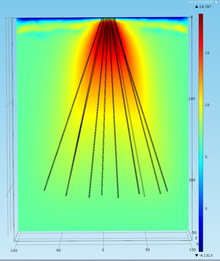
A field of connected boreholes can be used both for cooling, heating and storage purposes. The boreholes transfer heat to or from the ground, which over time changes the temperature in the ground. It is important that the borehole field is properly sized and evaluated before the ... Read More
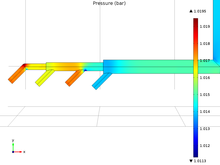
COMSOL Multiphysics has been used to validate and check the design of a header transporting ammonia gases released from pressure safety valves (PSVs) to the tip of the flare. The header is part of a dedicated flaring system to contain emissions from ammonia storage tanks. The two main ... Read More
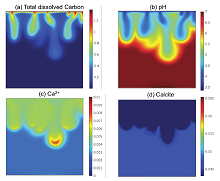
The capture and storage of CO2 in deep geological formations is one of the proposed solutions to reduce CO2 emissions to the atmosphere. CO2 is injected as a supercritical fluid deep below a confining geological formation that prevents its return to the atmosphere. A configuration of ... Read More
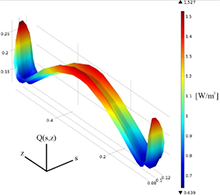
A model utilizing interdimensional variable coupling is presented for simulating the thermal hydraulic interactions of the High Flux Isotope Reactor (HFIR) core at Oak Ridge National Laboratory (ORNL). The model’s domain consists of a three-dimensional fuel plate and a two-dimensional ... Read More

During the manufacturing of CFRP components one of the most critical process steps is the vacuum bagging. In this process several layers of material are draped separately over complex part shapes. The specific properties of each material, which are needed for the process (i. e. breather, ... Read More
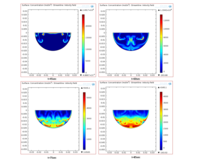
Optimal storage of carbon dioxide (CO2) in aquifers requires dissolution in the aqueous phase. Transfer of CO2 from the gas phase to the aqueous phase or oil phase would be slow if it were only driven by diffusion. Dissolution of CO2 in brine (oil) forms a mixture that is denser than the ... Read More
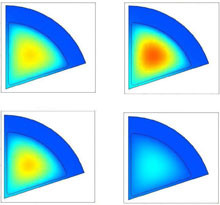
A two-dimensional mathematical model for the absorption and desorption of H2 in LaNi4.8Al0.2 was developed and experimentally validated. The model is composed of an energy balance, a mass balance and a momentum balance. These differential equations are numerically solved by means of the ... Read More