
See How Modeling and Simulation Is Used Across Industries
Multiphysics modeling and simulation drives innovation across industries and academia — as is evidenced by the many uses showcased in the technical papers and posters presented by engineers, researchers, and scientists at the COMSOL Conference each year.
Draw inspiration from the recent proceedings collected below, or, to find a specific presentation or filter by application area or conference year/location, use the Quick Search tool.
View the COMSOL Conference 2025 Collection

Technologies based on micro electro mechanical systems (MEMS) present advantages for rheological applications as they enable the fabrication of smaller sensors with faster response times. In this work we propose fabrication parameters and simulation of a MEMS viscometer. This research ... Read More

In our recent experiments we are revisiting the topografiner technology for the imaging of surface topography with a resolution of a few nanometers. In these new technique called Near-Field Emission Scanning Electron Microscopy (NFESEM), low-energy electrons are emitted from a ... Read More
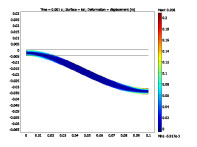
Manuel Collet is a member of the Department of Applied Mechanics of the FEMTO-ST Institute. He graduated with a degree in Mechanical Engineering from Ecole Centrale de Lyon in 1992 and obtained his PhD in 1996 about Active control of vibrating structures by mean of semi distributed ... Read More
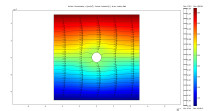
The paper presents and compares two models for simulating magneto-hydrodynamic flow of RedOx electrolyte in a conduit patterned with circular pillars. The first model solves the coupled Nernst-Planck and Navier-Stokes equations subjected to Butler-Volmer electrode kinetics and provides ... Read More

Micro cantilevers are the basic MEMS structures, which can be used both as sensors and actuators. The . The objective of this work is to study concept of pull-in voltage and how to reduce the same. Voltage is applied to upper cantilever beam and lower contact electrode is made as ground. ... Read More
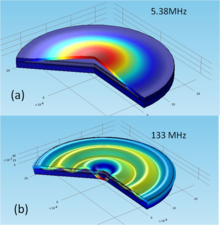
We simulate a Capacitive Micromachined Ultrasound Transducer (CMUT) using COMSOL Multiphysics® software. The CMUT is an electromechanical system, therefore, we couple the physics of electrical and structural mechanics to describe its dynamics. We obtain the distributions of the electric ... Read More
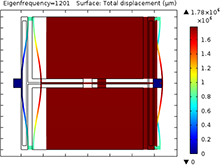
Introduction: Vibration energy harvester can convert mechanical vibration energy into electrical energy and store it in battery for later use. It can create clean renewable energy from vibration movements such as walking, jumping, running, etc. This can convert energy previously wasted ... Read More

Hollow microstructures find numerous applications in microsystems, bioMEMS and microfluidic systems [1]. Consequently, one-step fabrication process of hollow polymeric microstructures by external electric field along with capillary forces, termed as electric field- assisted capillarity ... Read More
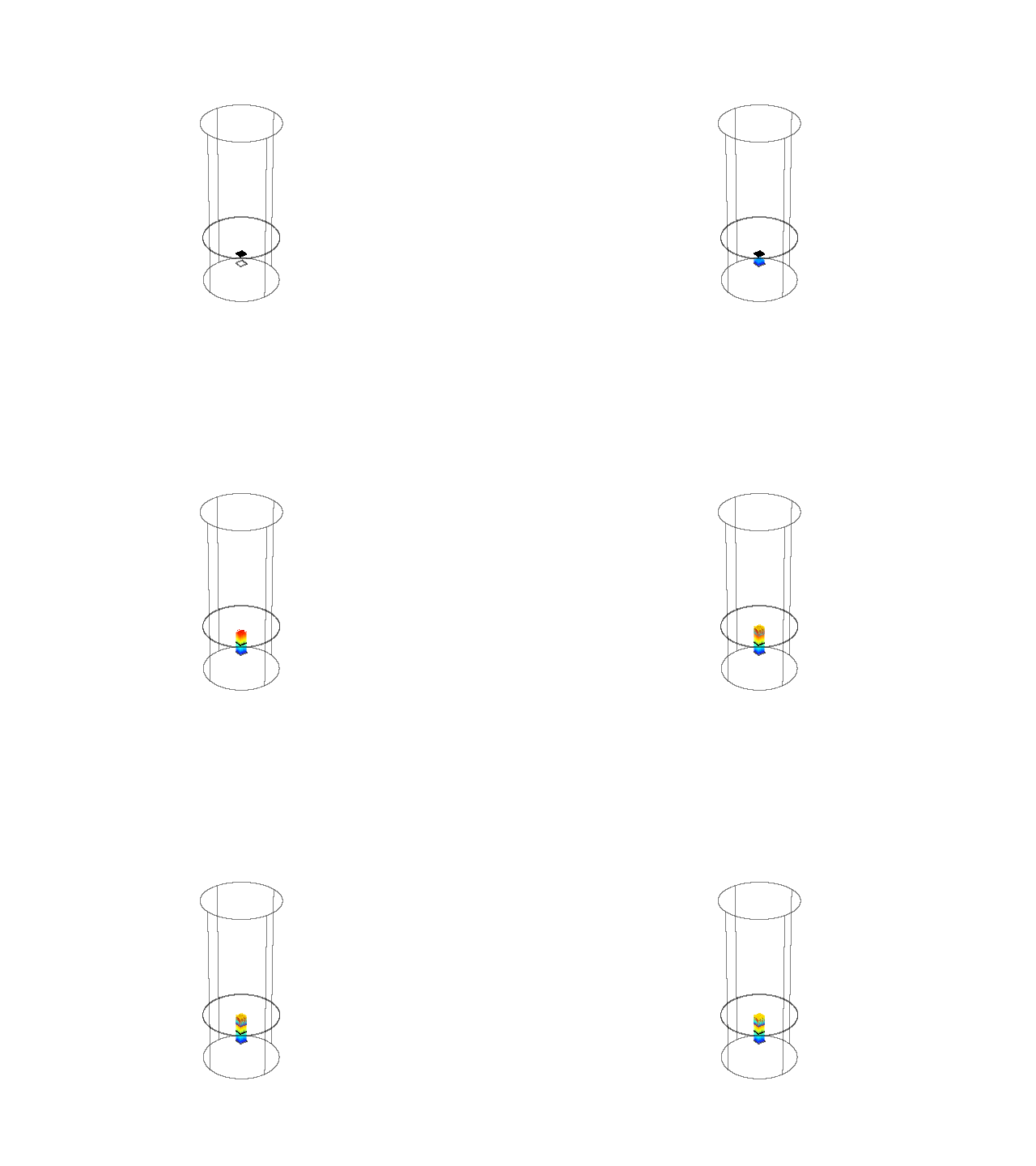
Vacuum phototriodes (VPT) have been used as photodetectors for many years in particle physics experiments. For example, they were used in the OPAL experiment at LEP and are currently used in the endcap Electromagnetic Calorimeter of the CMS experiment, at CERN’s Large Hadron Collider. ... Read More
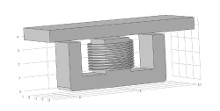
In this work, a methodology is developed, based on the application of finite element method in the frequency domain, using the COMSOL Multiphyics software, aiming the sensibility analysis of inductance calculation involving some configurations of an E-core magnetic circuit. Such ... Read More