
Explore the innovative ways multiphysics simulation is being used worldwide to advance research
Multiphysics modeling and simulation drives innovation across industries and academia — as is evidenced by the many uses showcased in the technical papers and posters presented by engineers, researchers, and scientists at the COMSOL Conference each year.
Draw inspiration from the recent proceedings collected below, or, to find a specific presentation or filter by application area or conference year/location, use the Quick Search tool.
View the COMSOL Conference 2026 Collection

This paper introduces a multiphysics simulation framework for examining the impact of mechanical vibrations on lithium dendrite formation in lithium-ion batteries. We connected the lithium-ion battery, solid mechanics, and phase field physics interfaces using a custom model in COMSOL ... Read More

Verification for thermal performance of battery stack system is of critical importance during the design stage of any energy management system. The temperature of batteries during charging and discharging cycles should not exceed a permissible value. In current analysis work, ... Read More

Lithium-ion batteries (LIBs) have become a major choice for electric vehicles and renewable energy storage systems owing to their high energy density and high charging efficiency. While LIBs play a crucial role in meeting global energy demand, during long-term operation they undergo ... Read More

The existing lithium ion battery model in COMSOL’s Multiphysics software is extended to include the thermal effects. The thermal behavior of a lithium ion battery is studied during the galvanostatic discharge process with and without a pulse. The existing lithium ion battery model in ... Read More
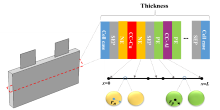
As the most important component of the entire lithium-ion battery, the electrodes, their design which ultimately determines the quantity and speed of lithium storage, directly affects the capacity, power density, and energy density of the battery. The electrochemical and thermal ... Read More

Over time, rechargeable batteries degrade and eventually stop working. You see some combination of declining capacity, rapid self-discharge, and reduced power. Degradation mode depends on battery design, but also on the application. Often, multiple physical processes contribute to ... Read More

Lead-acid battery is a reversible battery used generally automotive industry. A lead-acid battery cell contains two electrodes with pasted active material, an electrolyte and a separator. Electrode transmits current with electrons whereas electrolyte transmits current with ions. A grid ... Read More
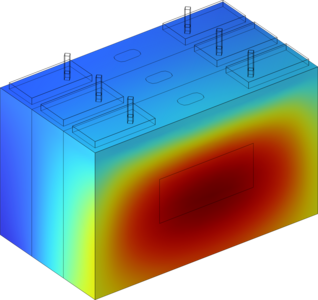
リチウムイオン電池の熱暴走および熱伝播挙動を高精度に予測する物理ベースシミュレーションは、電気自動車(EV)や定置用蓄電池に用いられる電池モジュール・パックの安全性評価において重要な役割を担っている[1]。熱暴走の発生およびセル間の熱伝播は、材料の熱物性や分解反応に伴う発熱特性に大きく依存する一方で、これらの物性値には測定誤差やばらつきが内在しており[2]、予測結果の不確実性要因となる点が課題である。 本研究では、比熱、熱伝導率、活性化エネルギー、ならびに熱分解反応に伴う潜熱を主要な不確かさ要因として選定し ... Read More


