
See How Modeling and Simulation Is Used Across Industries
Multiphysics modeling and simulation drives innovation across industries and academia — as is evidenced by the many uses showcased in the technical papers and posters presented by engineers, researchers, and scientists at the COMSOL Conference each year.
Draw inspiration from the recent proceedings collected below, or, to find a specific presentation or filter by application area or conference year/location, use the Quick Search tool.
View the COMSOL Conference 2025 Collection

An simple analytical model for the calculation of the resonance frequency of coils typical consists of a network of inductance, capacitance and resistance. Calculating these three parameters based on spatial geometry is not easy in most cases. The finite element method as used in COMSOL ... Read More

Additive Manufacturing is revolutionizing the industrial sector for complex and individualized metallic components. The most limiting factor of the widely established laser beam melting technology is the scan velocity due to inertia of the mirrors [1]. In electron beam melting (EBM), ... Read More
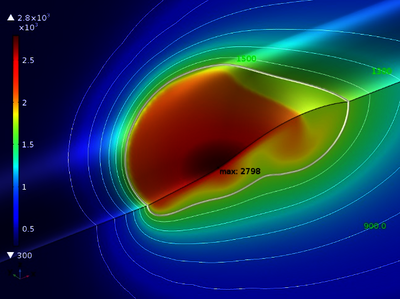
Arc current welding is a widespread process in heavy industry for the assembly of metallic components. In order to ensure the good quality of assemblies welds, it is appropriate to master the welding process but also to have a deep understanding of interactions with the weld pool and ... Read More

Dielectric elastomers are a promising group of smart materials, which finds application within many fields such as soft robotics, wave-energy harvesting, and loud speakers. A dielectric elastomer consists of a thin, stretchable polymer film sandwiched between two compliant electrodes. ... Read More
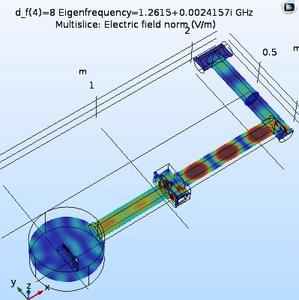
The acceleration of protons and ions by highly intense, ultra-short laser pulses is a very active field of experimental and theoretical research. From laser-plasma interactions the emission of a strong electromagnetic pulse (EMP) has often been reported as a side effect. It potentially ... Read More
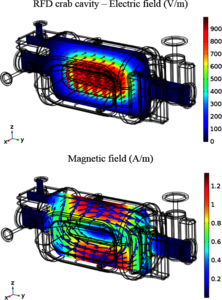
The Large Hadron Collider (LHC) is the world’s largest and most powerful particle accelerator. The LHC machine consists on a 27 km circumference tunnel that accelerates and collides proton beams and heavy ions. The High Luminosity LHC (HL-LHC) is a project aiming to upgrade the LHC ... Read More

Lyophilization is a food preservation process that allows to inhibit the growth of bacteria and other contaminants by removing water content in the processed food. Conventional vacuum dryers provide heat by thermal conduction to assist the phase change transformation, but if the product ... Read More

In the EMPIR project ADVENT the Scanning Microwave Microscopy (SMM) is investigated. The SMM is a still rather novel member of the family of scanning probe microscope. It has attracted a lot of attention recently, because this instrument can be used to characterize various electrical ... Read More

Real-time microstructure monitoring is important during the cooling process for hot-rolled strip steel production, as the microstructure formed determines the mechanical properties required by customers. The materials magnetic and electric properties, relative permeability and ... Read More

The transport of fluid through nanochannels is of importance in a variety of technological applications, including biological sensing, energy storage and conversion, chemical separation and many others. Synthetic nanofluidic architectures that mimic the gating functions of biological ion ... Read More


