
See How Modeling and Simulation Is Used Across Industries
Multiphysics modeling and simulation drives innovation across industries and academia — as is evidenced by the many uses showcased in the technical papers and posters presented by engineers, researchers, and scientists at the COMSOL Conference each year.
Draw inspiration from the recent proceedings collected below, or, to find a specific presentation or filter by application area or conference year/location, use the Quick Search tool.
View the COMSOL Conference 2025 Collection
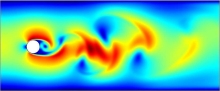
With offshore oil and gas exploration and production moving into ever deeper waters, the suspended length of marine risers (transporting hydrocarbons from the seabed to the surface) can easily exceed 3000 meters. One of the major design requirements for risers in (ultra) deep water is to ... Read More
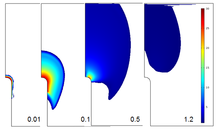
The design of modern electric insulation devices for medium and high voltage (HV) applications requires computational work that goes beyond solving just a Laplace equation for the electric potential, and limiting the electric field below critical values. Both field calculation and ... Read More
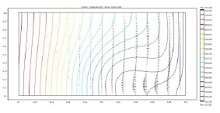
Here we investigate a promising passive cooling method through making advantage of the unique properties of ferrofluid. When a magnetic dipole or a permanent magnet is put at the hot side of a system, it will attract the cold ferrofluid to the hot place and displace the hot ferrofluid ... Read More

Crack detection is and has been an active field of exploration, both theoretical and applied for a number of years. It is the belief of this author that the concepts presented herein explore a new methodology for the modeling and the detection of cracks and families of cracks in ... Read More
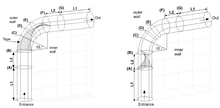
Non-Newtonian laminar flows in curved circular tubes with inserts are investigated by computer simulations. 0.65% solution of NaCMC is considered. Three-dimensional incompressible Navier-Stokes equations are solved using COMSOL Multiphysics. Placements of inserts inside the curved tubes ... Read More
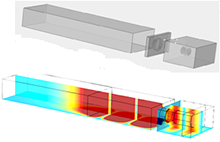
The measurement of dielectric constant at frequencies of 20 GHz or greater is important for specifying the optical properties of materials at millimeter wavelength. One method of measurement uses a resonant cavity containing a sample of the material, and relates the resonant frequency ... Read More
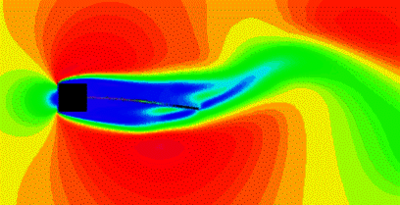
Fluid-structure interaction (FSI) refers to a class of problems in which the motions of fluid and solid are coupled. FSI is of great significance in many applications such as aero-elasticity, biomechanics, and design of various engineering systems. Typically, the multiphysics involved in ... Read More
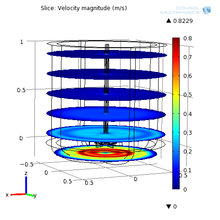
With detailed hydrodynamic modelling of a system the critical parameters and operation limits can be determined. In the field of fluid dynamic and reactor engineering one of the most important aspects is the practical knowledge of future engineers and technicians. In our research ... Read More

The thermocapillary effect is widely used in microfluidic applications for sensing and actuation and can also be used to generate rigid-body motion. Furthermore, it is possible to cast Marangoni flows to achieve controllable rigid-body motion in 3D space. To this effect, here we present ... Read More

Convective deposition is a material processing technique where an evaporating meniscus of a colloidal suspension is dragged along a solid substrate to deposit layers of micro or nanoparticles. The process is a typical multiphysics process where fluid dynamics, mass and heat transfer come ... Read More


