
See How Modeling and Simulation Is Used Across Industries
Multiphysics modeling and simulation drives innovation across industries and academia — as is evidenced by the many uses showcased in the technical papers and posters presented by engineers, researchers, and scientists at the COMSOL Conference each year.
Draw inspiration from the recent proceedings collected below, or, to find a specific presentation or filter by application area or conference year/location, use the Quick Search tool.
View the COMSOL Conference 2025 Collection
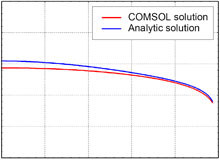
The present work is aimed at evaluating the capabilities of COMSOL Multiphysics® to treat heat transfer in Molten Salt Reactors (MSR). The analyzed situation is represented by the molten salt in turbulent regime flowing through a cylindrical channel surrounded by graphite, with both ... Read More

This paper presents the 3D model of pressure distribution in the process of magneto-rheological flow finishing. The effect of working gap on pressure distribution is studied using COMSOL Multiphysics® software. Also, the effect of different viscosity of fluids on development of pressure ... Read More
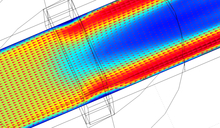
This article considers a closed water circuit with square cross section filled with an electrolyte fluid. The conductor fluid was moved using an electromagnetic pump, in which a permanent magnet generates a magnetic field and electrodes generate the electric field in the flow. Thus, the ... Read More

A fuel cell is an efficient and clean alternative power source of energy. Alkaline anion exchange membrane (AAEM) fuel cells are one in which conduction of oH- (hydroxyl ion) take place. The advantages of using alkaline fuel cells over proton exchange membrane fuel cells is that ... Read More
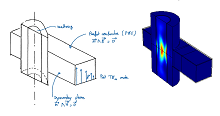
Introduction: The use of microwave energy for thermal cracking (from thermal stress and water pore pressure) of lignite-coal briquettes increases the lignite friability [1] and is beneficial for later chemical treatment inside a gasifier (for methanol production for example). An ... Read More

Electrostatic precipitators (ESP) are a reliable technology to control emissions of airborne particles in a series of applications such as coal-fired power plants, cement plants or even for domestic fireplaces. Numerical calculations allow further development of electrostatic ... Read More

This paper shows a model to estimate the scaling parameters for reverse osmosis membrane processes. The model takes into account the concentration polarization of ionic species in the membrane channel of spiral-wound modules and the effect of the spacers on the flow. The scaling ... Read More
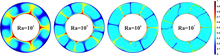
For the numerical solving of the equations, Comsol has been applied. Simulations have been modeled in 2D Cartesian, in cylindrical coordinate system and in a “mantle-like” cylindrical-shell. Mantle dynamics is controlled by the Rayleigh number (Ra), which is the ratio of the buoyancy ... Read More
Several commercial CFD companies have recently extended their codes to magnetohydrodynamic (MHD) flows. However, there are many computational challenges associated with MHD flows under the harsh fusion environmental conditions that require such codes to be carefully examined in a special ... Read More

Flows of electrically conducting liquids in external magnetic fields are present in several applications. In this kind of flow, the inhomogeneous magnetic field creates a breaking force on the conducting fluid. As a result, a stagnant zone is formed in the zone affected by the localized ... Read More


