
Explore the innovative ways multiphysics simulation is being used worldwide to advance research
Multiphysics modeling and simulation drives innovation across industries and academia — as is evidenced by the many uses showcased in the technical papers and posters presented by engineers, researchers, and scientists at the COMSOL Conference each year.
Draw inspiration from the recent proceedings collected below, or, to find a specific presentation or filter by application area or conference year/location, use the Quick Search tool.
View the COMSOL Conference 2025 Collection

Utilization of bioreactors to regenerate tissues outside the body has been intensely investigated in functional tissue engineering. Various studies have been performed using computational fluid dynamics (CFD) to understand fluid flow within bioreactors while assuming porous scaffold as a ... Read More
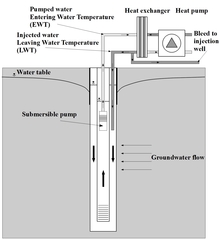
A fully coupled multiphysics model involving heat transfer and groundwater flow within a SCW and its surrounding ground was implemented in COMSOL Multiphysics 4.2a with MATLAB to simulate a 24-hour heating operation. The heat pumps were modeled using interpolation functions thereby ... Read More
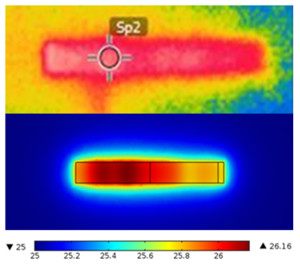
A piezoelectric transformer allows purely mechanical transfer and scaling of electrical energy via simultaneous utilization of both the direct and converse piezoelectric effects. This mechanical energy transfer enables a wide range of functional differences from typical magnetic-based ... Read More
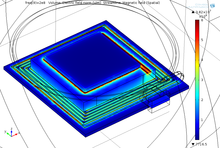
A wireless passive pressure sensor and the measurement system were design and simulated using COMSOL 4.3. The sensor is based on MEMS capacitor attached to a planar inductor for wireless powering and readout. An external coil is used for the measuring system. The pressure to be measured ... Read More

During the past decade reverse engineering has become a common and acceptable practice utilized by many aftermarket suppliers, and even original equipment manufacturers (OEM). This presentation focuses on the applications of multiphysics software such as COMSOL and Simpleware® in ... Read More

Electrofluidic transport through a single walled carbon nanotube (SWCNT) is enhanced by electroosmosis. Electroosmosis is made possible in these devices by the combination of a large slip length within SWCNTs and the interfacial potential at the solution/nanotube interface. A ... Read More
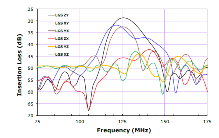
Surface acoustic wave (SAW) devices are commonly used as wireless filters, resonators, and sensors. The confinement of acoustic energy near the surface of a piezoelectric substrate in a SAW sensor makes it highly sensitive for discerning surface perturbation. As sensors, SAW devices have ... Read More

Thermoplastic composite such as APC2 (Carbon/PEEK) are usually shipped as semi-finite tape products. Final product is obtained with forming by applying heat and pressure. A key phenomena is the squeezing of the tape. In this paper we compare the solution of the squeeze flow using a ... Read More


