
Explore the innovative ways multiphysics simulation is being used worldwide to advance research
Multiphysics modeling and simulation drives innovation across industries and academia — as is evidenced by the many uses showcased in the technical papers and posters presented by engineers, researchers, and scientists at the COMSOL Conference each year.
Draw inspiration from the recent proceedings collected below, or, to find a specific presentation or filter by application area or conference year/location, use the Quick Search tool.
View the COMSOL Conference 2025 Collection

Reactive extraction of organic acids from an aqueous solution to an alkaline stripping fluid is based on a selective barrier allowing permeation of non-polar molecules, which subsequently react with the stripping agent. The shift from the organic acid to its base induced by the chemical ... Read More
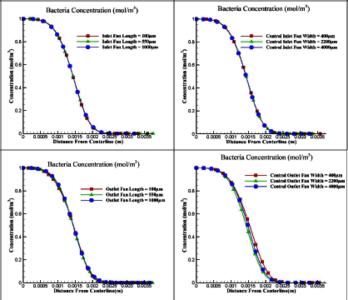
The ubiquitous nature of biofilms has led to a growing need to be able to detect, control, and maintain or remove them. Therefore a robust testing platform that allows for multiple analytical techniques is required to better understand their multitude of properties. The development of ... Read More

This paper presents a 3D numerical model to predict the whole process of coaxial powder flow, including the particle stream flow in and below the nozzle and also the laser-particle interaction process. The Particle Tracing Module of COMSOL Multiphysics is used to solve the coupled ... Read More
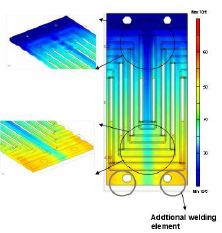
Metallic bipolar plates promise several advantages for fuel cell applications. On the other hand, cooling of these plates is a critical task regarding design optimization. The high thermal conductivity of the material and the complex geometry of these plates affect directly the cooling ... Read More

Most conventional wastewater treatment processes are quite energy-intensive. Global wastewater production is increasing due to growth in population, industrialization, and urbanization, creating an urgent need for energy-efficient wastewater treatment technologies. Moreover, waste ... Read More

Capillary effects are common in microfluidics due to large surface-to-volume ratio of flows inside microchannels. In biological or chemical analysis, capillary flow is used for the transport of liquid and mixing enhancement, without applying any external means. It’s used in biochemical ... Read More
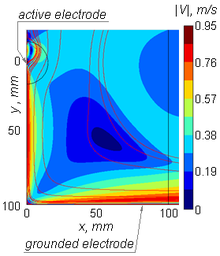
Ionic wind is the gas flow induced by the corona discharge. Ions produced by corona are accelerated by electric field and transfer their momentum to neutral molecules. Using ionic wind one can convert electric energy to kinetic energy of air flow almost directly. The phenomenon of ionic ... Read More
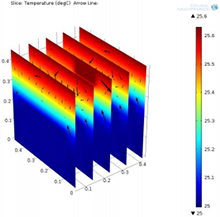
This paper presents a study on the heat generation of Valve-Regulated Lead Acid (VRLA) batteries used in off-grid streetlighting applications from PoleCo, a Halifax based company. One goal of the project was to produce validated COMSOL® models of the enclosure that holds these VRLA ... Read More

A resonant MEMS sensor for viscosity and mass density measurements of liquids was modeled. The device is based on Lorentz-force excitation and features an integrated piezoresistive readout. The core sensing element is a rectangular vibrating plate suspended by four beam springs. The ... Read More
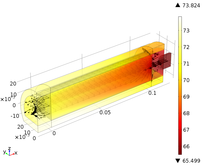
Heat sinks for cryogenic applications using helium gas as the coolant are not readily available. They require to be designed specifically for the intended application. A finite element model was developed to study the feasibility and optimize the design. The FEM computing package COMSOL ... Read More


