
See How Modeling and Simulation Is Used Across Industries
Multiphysics modeling and simulation drives innovation across industries and academia — as is evidenced by the many uses showcased in the technical papers and posters presented by engineers, researchers, and scientists at the COMSOL Conference each year.
Draw inspiration from the recent proceedings collected below, or, to find a specific presentation or filter by application area or conference year/location, use the Quick Search tool.
View the COMSOL Conference 2025 Collection
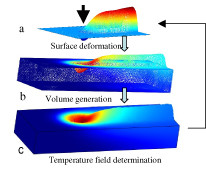
Hybrid laser-MIG arc welding has very interesting advantages compared to laser welding or arc welding used separately. It is known that improvement of productivity results in higher welding speeds, thicker welded materials, joint fit-up allowance, better stability of molten pool, and ... Read More
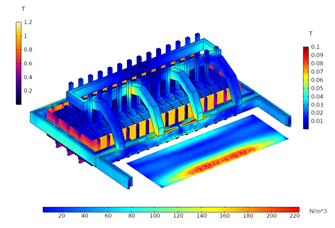
Aluminum production potlines operate under significant amperage in a range of 200 kA – 600 kA. High electrical DC currents induce strong magnetic fields. MHD stability, which is a result of electrical current and magnetic field interaction within aluminum reduction cell, is one of highly ... Read More
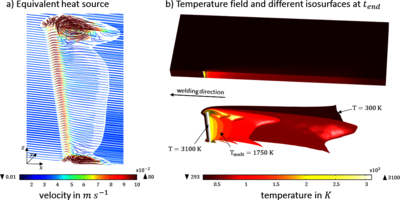
The Finite Element Method (FEM) has become an established numerical tool used for different academic and industrial purposes. It allows the prediction of weld pool geometry, thermal cycle, final distortion and residual stress field during and after fusion welding. The capability of the ... Read More
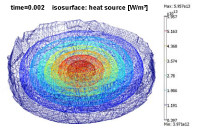
Additive Layer Manufacturing (ALM) methods, like Electron Beam Sintering (EBS), constitute an interesting process concerning the production of small series and customized products. However, transient effects occur during processing due to the different physical principles of an electron ... Read More
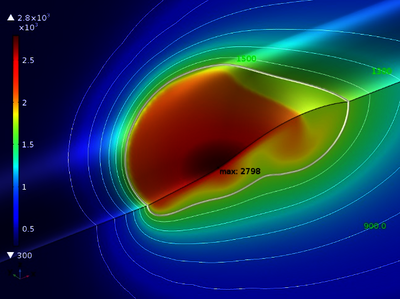
Arc current welding is a widespread process in heavy industry for the assembly of metallic components. In order to ensure the good quality of assemblies welds, it is appropriate to master the welding process but also to have a deep understanding of interactions with the weld pool and ... Read More
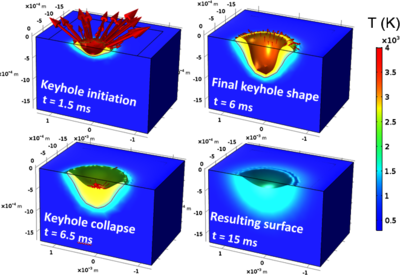
The interaction of high power laser beam with metallic materials produces a number of interconnected phenomena that represent a serious challenge for numerical modeling, especially for creation of auto-consistent models. Additional difficulty consists in lack of data on materials ... Read More

Thermal energy storage systems receive notable attention within the framework of energy management due to their ability of bridging thermal energy demand and supply, thus leading to an overall efficiency increase. The key component in such systems are materials which convert ... Read More

Improved performance of aeroengines requires the development of new manufacturing technologies for ceramic matrix composites (CMCs). This has been simulated using COMSOL Multiphysics. Specialized simulation technologies have been developed to describe the infiltration of molten material ... Read More

Electrospinning is a process where high voltage is applied to produce polymer fibers of nanoscale diameter. Various polymers have been used for this process in molten form or as a solution with an appropriate solvent such as glycerol. The melt solidifies while the solvent evaporates to ... Read More

Laser-based powder bed fusion (LPBF) is a promising additive manufacturing technology, where metallic parts are produced in a layer-wise manner. At each step, a rapid-moving laser irradiates and subsequently melts predefined zones of a relatively thin layer of fine spherical metal ... Read More


