
See How Modeling and Simulation Is Used Across Industries
Multiphysics modeling and simulation drives innovation across industries and academia — as is evidenced by the many uses showcased in the technical papers and posters presented by engineers, researchers, and scientists at the COMSOL Conference each year.
Draw inspiration from the recent proceedings collected below, or, to find a specific presentation or filter by application area or conference year/location, use the Quick Search tool.
View the COMSOL Conference 2025 Collection
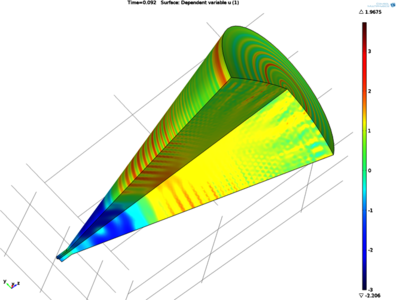
Amplitude of acoustic waves can be magnified by conical or concave waveguides, like in ear trumpets or fjords (surface waves). The simplest way realizing a capable device is a conical waveguide with a target to be treated in the top of the cone, and a spherical actor or acoustic exciter ... Read More

The main focus of the present study is the parametric investigation of the influence of viscosity on breakup dynamics of the non-Newtonian sodium carboxymethylcellulose (CMC) droplets. It presents the numerical simulations of the fluid dynamics of CMC droplets with shear-thinning ... Read More
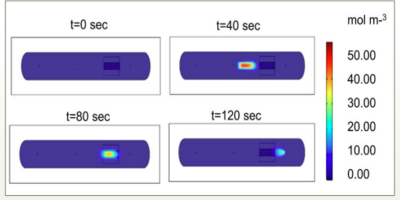
The design of highly-sensitive thermoelectric microfluidic sensors for the characterization of biochemical processes is an important area of engineering research. This study reports three-dimensional numerical analysis of the critical design parameters of a continuous-flow biosensor with ... Read More

In solution, sodium dodecyl sulfate (SDS) (structure shown in Fig. 1) can form a boundary film on metal surfaces. Previous studies have extensively investigated the characteristics of such surfactant films experimentally [1][2][3]. A dependency of SDS surface concentration and film ... Read More

The COMSOL® app library of the Technical University of Munich is a collection of applications for simulating acoustic phenomena. They are used in the teaching of acoustics to visually represent fundamental vibrational aspects and provide learners with a visual understanding. In the ... Read More

Scraped surface heat exchangers (SSHEs) are commonly used in the food, chemical, and pharmaceutical industries for heat transfer, crystallization, and other continuous processes. One of the factor posing difficulties to heat transfer is viscosity. Highly viscous fluids tend to generate ... Read More

Dynamic measurement of magnetic particles in continuous flow devices is made very difficult by the limitations imposed by the sensors themselves. Thus, certain sensor layouts are restricted to either number sensitive or spatial resolutive measurements of magnetic particles. We ... Read More

INTRODUCTION: Microfluidics, as a crucial technology of recent years, enables numerous applications for Point-of-Care-Testing such as Lab-on-Chip-Systems (LOC) or Micro-Total-Analysis-Systems (µTAS) and is exceptionally well-suited for cell sorting or DNA trapping. Especially the ... Read More

Non-communicable diseases (NCDs) have globally become a prevalent problem, accounting for more than 60% of the mortality worldwide. NCDs impose socioeconomic consequences to low-income countries as 80% of NCD deaths occur in such countries [1, 2]. The World Health Organization has ... Read More

Scraped-surface heat exchangers (SSHEs) handle products that are viscous, that contain particles, and that tend to deposit on the heat transfer surface. The rotating scraper blades continuously remove any deposition on the heating or cooling surface, thereby maintaining the efficiency of ... Read More


