
Explore the innovative ways multiphysics simulation is being used worldwide to advance research
Multiphysics modeling and simulation drives innovation across industries and academia — as is evidenced by the many uses showcased in the technical papers and posters presented by engineers, researchers, and scientists at the COMSOL Conference each year.
Draw inspiration from the recent proceedings collected below, or, to find a specific presentation or filter by application area or conference year/location, use the Quick Search tool.
View the COMSOL Conference 2025 Collection

Targeted drug delivery systems have been wildly studied in cancer therapy due to the toxicity of most of chemotherapeutic drugs. Nanoparticles can be attached to the small molecules of the drugs and serve as drug carriers to deliver the drug molecules into the area of interest. In this ... Read More
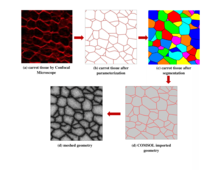
Turgor pressure loss and pectin degradation result in texture loss during cooking of plant based materials. To simulate texture loss, a simultaneous heat and moisture transfer, pectin degradation in the cell wall material and solid mechanical model was developed at the microscale using ... Read More

A 3D finite element analysis is carried out, using COMSOL® software, to reproduce the thermal profile obtained with Rosenthal’s equation. The implemented heat transfer equation has been modified as a means to approximate Rosenthal’s solution. An analysis of the differences between the ... Read More

Neste trabalho é analisado o comportamento dos perfis de temperatura e umidade e sua penetração em bobinas de papel submetidas a longos períodos de armazenagem. O modelo considera a transferência simultânea de calor e massa com o efeito Soret, mas sem o efeito Latour. O sistema é fechado ... Read More
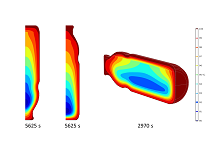
Determination of the temperature in liquid foods may be derived by measurements or by modeling. However, the placement of thermocouple probes to record temperature in the container disturbs the flow patterns. For this purpose, Computational fluid-dynamics (CFD) offers a powerful tool for ... Read More
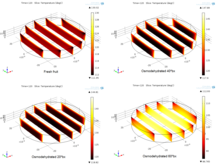
Recent studies have been devoted to develop mathematical models to simulate the food processing using the porous media approach. The aim of this study is to simulate the microwave drying of osmodehydrated food by means of modeling the mass, energy and momentum transfer using the porous ... Read More

Plasma technology has potential applications in a wide range of areas, such as microwave reflectors/absorbers, material processing, sterilization and chemical neutralization. The knowledge about the fluid behavior in such systems has a central role, since the stability of the flow in the ... Read More

Schistosoma mansoni parasites affect million people worldwide. The intensity of the infection can be evaluated by the number of eggs present in the stool of an infected individual. The application of the traditional methods has been regarded as impractical in developing areas and there ... Read More

The objective of this simulation effort is to develop a mathematical model of vacuum desorption on a POC (Proof of Concept) canister loaded with Zeolite 13X/5A . This canister contains a pelletized adsorption bed which is used to adsorb H2O and CO2. Once this bed is fully saturated with ... Read More

The flow morphology of two immiscible fluids in a microfluidic device finds numerous applications such as emulsification, synthesis of nanomaterials [1], lab-on-a-chip devices and biological analysis [2]. It offers many advantages over the conventional macroscopic devices because of its ... Read More


