
Konica Minolta Uses Simulation to Study and Optimize OLED Devices
Leiming Wang, Konica Minolta Laboratory, USA
As the demand for lightweight and flexible electronics continues to increase, so does the demand for lightweight and flexible light sources. Organic LEDs (OLEDs) have garnered tremendous interest because of their inherent elasticity, but suffer from a lack of brightness and efficiency. Researchers at Konica Minolta are working to alleviate these limitations and minimize light lost in their OLED designs. Using the COMSOL Multiphysics® software, they simulated the electromagnetic field and light emission distribution for a variety of nanostructured cathode geometries, determined the optimal configuration, and were able to cut light losses in half.
Suggested Stories
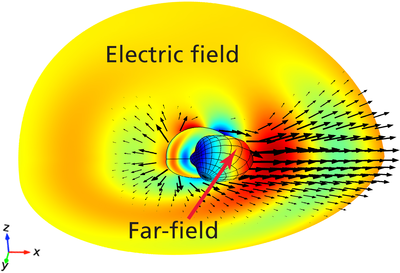
Scattering of Electromagnetic Waves by Particles
When electromagnetic waves propagate through matter, they interact with inhomogeneities and particles that can locally ...
Simulation-Based Design of New Implantable Hearing Device
Cochlear Technology Centre Europe (CTCE) develops new technology for hearing implants. Their current work is with a ...
Giving Furniture Testing a Leg Up
Chairs must meet quality standards, which requires lengthy and costly testing. To reduce the burden on manufacturers, ...
Radio-Frequency-Induced Heating of Medical Devices in MRI Systems
MED Institute Inc., a full-service contract research organization (CRO) for the medical device industry, is using ...


