
Ivana Milanovic, University of Hartford, USA
While covering the required fundamental material in undergraduate academic programs is the top priority, students require an extra set of knowledge and skills to flourish in the workforce. This is especially true in science, technology, engineering, and mathematics (STEM) fields, where there is rarely an abundance of time for inquiry-based learning and the development of field-specific skills. To address this issue, the University of Hartford integrated multiphysics modeling into their curricula. Using the Application Builder in the COMSOL Multiphysics® software, the university created simulation-based laboratory assignments through apps, which enhanced students’ physical intuition and their ability to visualize physical concepts.
Suggested Stories

The Growing Use of Simulation in the Biomedical Industry
From implants and stents to MRI and spinal cord stimulation, numerical modeling is paramount to biomedical device ...
From Spreadsheets to Multiphysics Applications, ABB Continues to Power Up the Transformer Industry
The buzzing sound you sometimes hear when walking past high-voltage transmission lines is caused by transformers used ...
Current Transformer Design That Combines Finite Element Analysis and Electric Circuit Simulation
Transformers have been around for quite a while but their fundamentals are still being investigated by ABB in ...
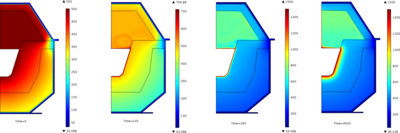
When it’s Impossible to Take Actual Measurements, Multiphysics Provides the Answers
To contain splashes and provide protection at plants where metal is fabricated, blast furnace runners need a roof made ...


