
Electrodynamics of a Power Switch — Multibody Version
Application ID: 78191
Electrical events, such as an overcurrent or overload, can seriously damage electrical circuits or power lines. To avoid expensive replacements of critical parts, circuit breakers can be installed. These mechanically interrupt the current flow or surge by moving a plunger as soon as a critical current is reached. In contrast to a fuse, which has to be replaced after it has been activated to protect the surrounding electrical components, a circuit breaker can be reset.
The main purpose of this tutorial model is to explore the working principle and some possible solutions for modeling one class of circuit breakers: magnetic power switches. These are electromechanical devices in which iron plungers are moved by means of the magnetic attraction exerted by current flowing in coils surrounding them. Turning off the driving current resets the switch to its initial state.
The model simulates rigid body dynamics under the influence of magnetic forces, induced currents, and spring and constraint arrangements that keep the plunger in its equilibrium position. A copper coil is placed on the central leg of a lower E-core, which is kept fixed. As current flows in the coil, an attractive force is exerted on the upper E-core (the moving plunger), which is held in place by a prestressed spring. When the force reaches a threshold value, the plunger moves toward the lower E-core, closing the air gap. The model illustrates how to simulate the plunger motion and closing time, with the closing time depending on the spring stiffness.
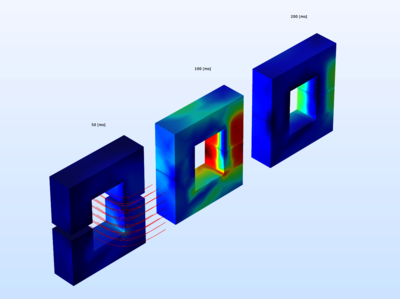
This model example illustrates applications of this type that would nominally be built using the following products:
however, additional products may be required to completely define and model it. Furthermore, this example may also be defined and modeled using components from the following product combinations:
The combination of COMSOL® products required to model your application depends on several factors and may include boundary conditions, material properties, physics interfaces, and part libraries. Particular functionality may be common to several products. To determine the right combination of products for your modeling needs, review the Specification Chart and make use of a free evaluation license. The COMSOL Sales and Support teams are available for answering any questions you may have regarding this.


