
The Application Gallery features COMSOL Multiphysics® tutorial and demo app files pertinent to the electrical, structural, acoustics, fluid, heat, and chemical disciplines. You can use these examples as a starting point for your own simulation work by downloading the tutorial model or demo app file and its accompanying instructions.
Search for tutorials and apps relevant to your area of expertise via the Quick Search feature. Note that many of the examples featured here can also be accessed via the Application Libraries that are built into the COMSOL Multiphysics® software and available from the File menu.
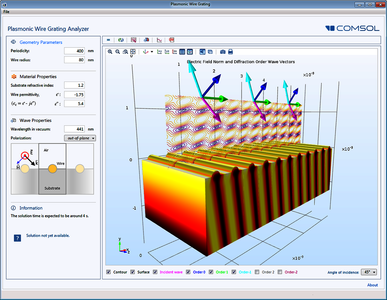
Surface plasmon-based circuits are being used in applications such as plasmonic chips, light generation, and nanolithography. The Plasmonic Wire Grating Analyzer application computes the coefficients of refraction, specular reflection, and first-order diffraction as functions of the ... Read More
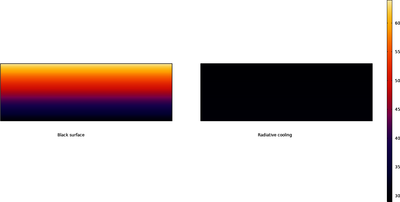
Because the atmosphere is nearly transparent to wavelengths in the range 8 to 13 µm (atmospheric window) for a clear sky, it is possible to cool down a surface even during a sunny day. This model compares the temperature distribution on a concrete block exposed to ambient and solar ... Read More
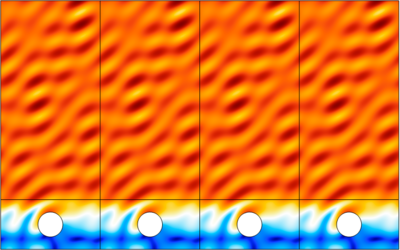
This is a model of acoustic absorption by a porous acoustic open cell foam. In porous materials the sound propagates in a network of small interconnected pores. Because the dimensions of the pores are small, losses occur due to thermal conduction and viscous friction. Acoustic foams are ... Read More
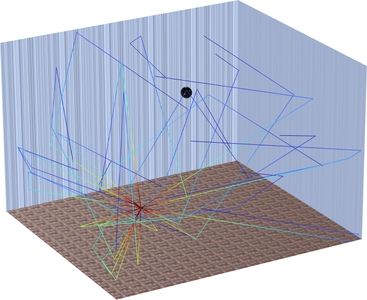
This model shows one approach for obtaining a broadband impulse response by combining ray-tracing and finite element methods. The combination is done all within COMSOL® and uses idealized filters. In this example, the simulation results are further compared to an analytical solution ... Read More
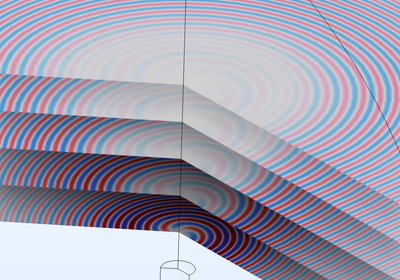
Model of the sound radiation from a circular duct with uniform flow. The convected acoustic problem is described using the linearized potential flow equations, solved in the frequency domain. The acoustic inlet is treated including higher order modes using the Port boundary condition and ... Read More

In this model, the scattering coefficient of a Schroeder diffuser is calculated. This coefficient can then be used as input to express boundary conditions in typical room acoustic simulations. The effect of periodicity is also investigated by studying the responses from different ... Read More
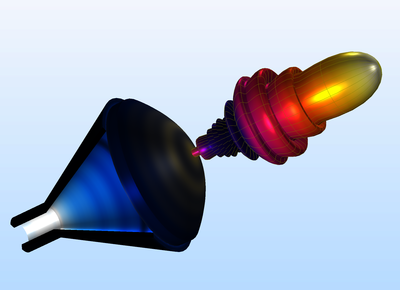
An axisymmetric 3D structure such as a conical horn antenna can be simulated in a fast and efficient way using only its 2D layout. In this model, the antenna radiation and matching characteristics are computed very quickly with respect to the dominant TE mode from the given circular ... Read More

This model shows how to use the scattered field formulation to compute the transmission coefficient for impinging P and S plane elastic waves onto a finite size phononic crystal. The transmission tends to zero in the frequency range corresponding to P- and S-wave band gaps, as ... Read More
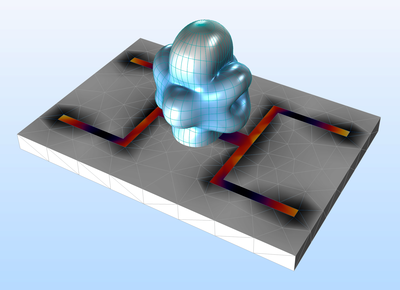
A wideband antenna study, such as an S-parameter or far-field pattern analysis, can be obtained by performing a transient response analysis and a time-to-frequency fast Fourier transform (FFT). This model runs a time dependent study first and then transforms the dependent variable, the ... Read More
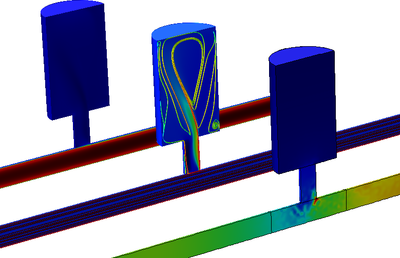
Helmholtz resonators are used in exhaust systems, as they can attenuate a specific narrow frequency band. The presence of a flow in the system alters the acoustic properties of the resonator and the transmission loss of the subsystem. In this tutorial model, a Helmholtz resonator is ... Read More