
The Application Gallery features COMSOL Multiphysics® tutorial and demo app files pertinent to the electrical, structural, acoustics, fluid, heat, and chemical disciplines. You can use these examples as a starting point for your own simulation work by downloading the tutorial model or demo app file and its accompanying instructions.
Search for tutorials and apps relevant to your area of expertise via the Quick Search feature. Note that many of the examples featured here can also be accessed via the Application Libraries that are built into the COMSOL Multiphysics® software and available from the File menu.
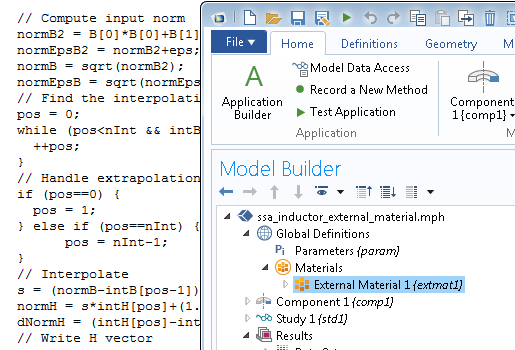
The AC/DC magnetic interfaces support material models defined in external C code. You can access external material functions, written in C code, which have been compiled into a shared library. By writing a wrapper function in C code, you can also use material functions written in another ... Read More
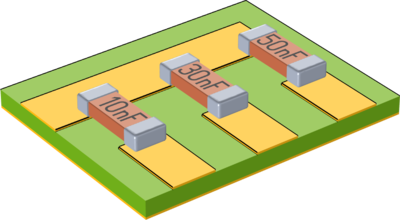
These models demonstrate the usage of the user defined lumped port and lumped elements to introduce excitations and lumped circuit elements between volumetric conductors. Additional models show how to use impedance and transition boundary conditions to model the conductors, instead of ... Read More
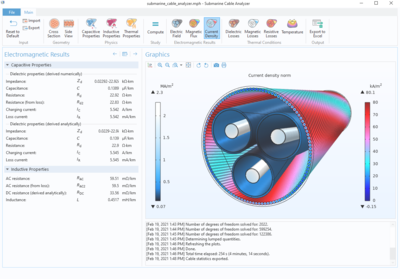
This application demonstrates how the Application Builder in the COMSOL Multiphysics® software can be used to make advanced cable modeling available to a general audience. At its core is a multiphysics model based on the technology introduced in the Cable Tutorial Series. The ... Read More
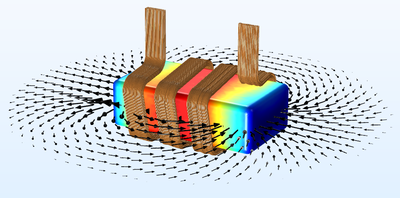
A demo model of a 50 Hz AC coil wound around a ferromagnetic (linear) core. The model is intended as a tutorial to show how to create a relatively complex geometry and set up the new Multi-Turn Coil features for the simulation. The model requires the Design module to fillet the edges of ... Read More
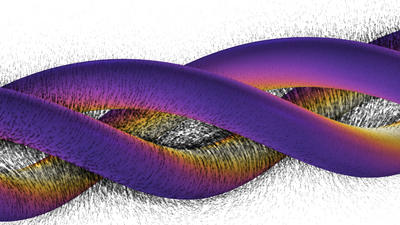
These models demonstrate various ways of exciting magnetic fields using the Magnetic Field Formulation interface in the AC/DC Module, an add-on to the COMSOL Multiphysics® software. To learn more about these models, see the accompanying blog post “Modeling of Excitations with ... Read More
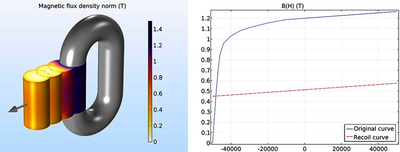
Soft permanent magnets like AlNiCo are easily demagnetized if handled incorrectly. This is a demonstration of how to model the self-demagnetization of a cylindrical AlNiCo magnet when moved out of its associated/protective magnetic circuit. The modeling is performed in three steps: The ... Read More
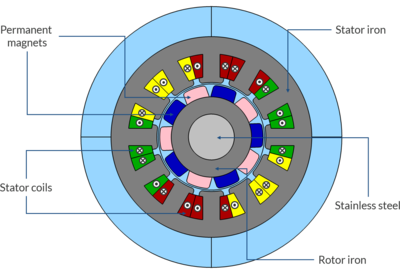
This is a primer model of a permanent magnet machine. It is a generic model that can be modified to simulate a motor or generator. It demonstrates different capabilities of COMSOL Multiphysics® to examine aspects of machine design, such as air gap magnetomotive force (MMF), ... Read More
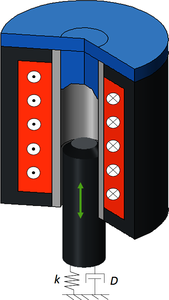
This is a transient model of an electromagnetic plunger with stopper restricting the linear motion. The model consists of a magnetic core, nonmagnetic guider, multi-turn coil, nonmagnetic stopper/blocker, and magnetic plunger attached to the spring and damper at the base. The ... Read More
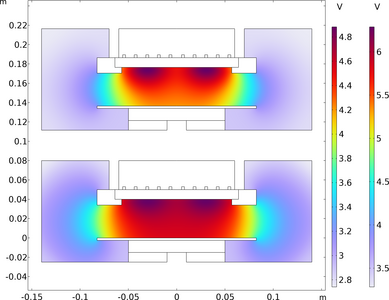
Electron transport in low-temperature plasmas depends strongly on the electron energy distribution function (EEDF), which is often approximated as Maxwellian but is frequently nonequilibrium in reality. Incorporating nonequilibrium EEDF behavior into spatially dependent models often ... Read More
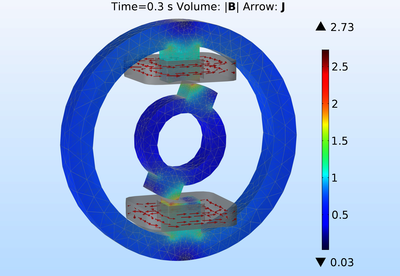
Switched reluctance motors work on the principle of reluctance torque. The stator and rotor will interact to minimize the reluctance for the flux path. This application simulates the behavior of the motor when the stator winding is excited with a step voltage and when the rotor is at a ... Read More


