
The Application Gallery features COMSOL Multiphysics® tutorial and demo app files pertinent to the electrical, structural, acoustics, fluid, heat, and chemical disciplines. You can use these examples as a starting point for your own simulation work by downloading the tutorial model or demo app file and its accompanying instructions.
Search for tutorials and apps relevant to your area of expertise via the Quick Search feature. Note that many of the examples featured here can also be accessed via the Application Libraries that are built into the COMSOL Multiphysics® software and available from the File menu.

In this model, we use the Pressure Acoustics, Boundary Elements physics interface to analyze the acoustics of a generic head and torso simulator. This is a manikin head used to do standardized measurements for hearing aids, mobile phones, and headphones. The model showcases some ... Read More
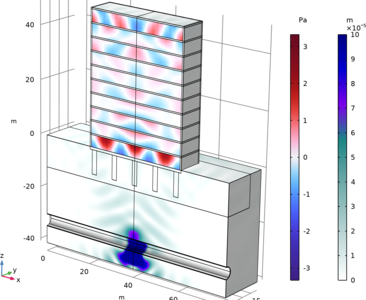
Underground train grids span large areas under London, Paris, New York, and other cities. The building regulations require strict noise standards, and failure to comply could result in significant losses in the market prices of developments. Therefore, train-induced noise has to be ... Read More
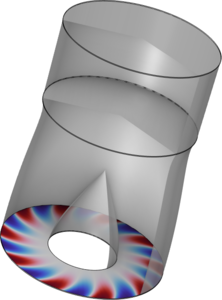
The acoustic field in a model of an axially symmetric lined aero-engine duct, based on modal sound transmission, is analyzed. The source is generated by a single mode excitation at a boundary. Sources and nonreflecting conditions are applied using port boundary conditions. The model ... Read More
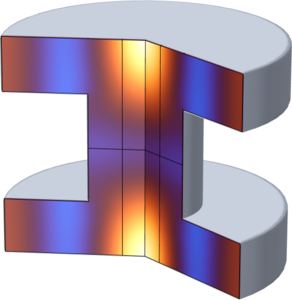
This is a model of a simple photoacoustic (or optoacoustic) resonator. A pulsating laser heats a gas causing expansion and contraction and thus creates pressure waves. Such devices are used as sensors for measuring material parameters of the gas inside the resonator. The resonance ... Read More

This model presents the flow noise generated by flow past the so-called tandem cylinder configuration. The test is part of the “First Workshop on Benchmark problems for Airframe Noise Computations”. The tutorial model shows the steps involved in a flow-induced noise simulation in COMSOL ... Read More
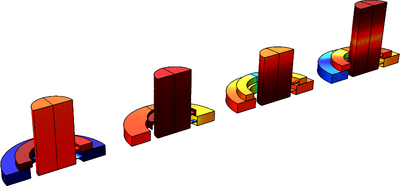
In this tutorial the geometry of an occluded ear-canal simulator is optimized to match the acoustic response of a given ear. The target data in this model stems from a simulation of an ear canal, but it can also be based on measurements, or a response specified by a standard. Read More
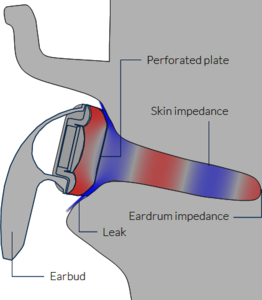
This conceptual model analyzes the influence of leaks on the acoustic response of an earbud speaker placed in an ear-canal-like geometry. Built-in impedance models are used to capture the effects of a perforated plate in front of the speaker, skin impedance, and ear drum impedance. The ... Read More
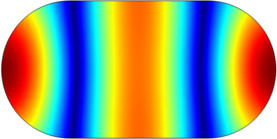
In this model, compute the propagating modes in the chamber of an automotive muffler. The geometry is a cross-section of the chamber in the Absorptive Muffler example. The model’s purpose is to study the shape of the propagating modes and to find their cut-off frequencies. As discussed ... Read More
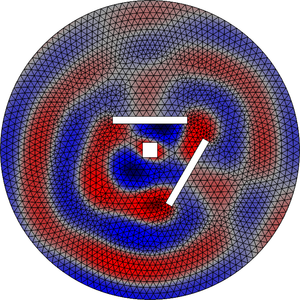
This simple tutorial model shows how to set up a parametric sweep over a number of frequency bands (octaves or 1/3 octaves) and remesh once per band. A frequency sweep is performed within each band, which now has an adequate mesh resolution. This approach saves some computational effort ... Read More
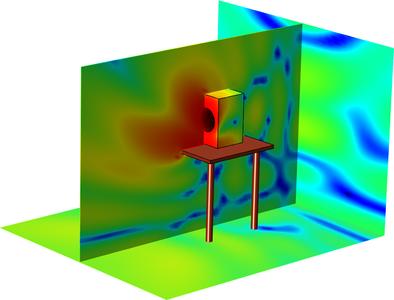
In this tutorial, the acoustic radiation pattern from a small generic loudspeaker is analyzed using the boundary element method (BEM). The loudspeaker is located on a small table above the floor and at a given distance from a wall. The model is set up using the Pressure Acoustics, ... Read More


