
The Application Gallery features COMSOL Multiphysics® tutorial and demo app files pertinent to the electrical, structural, acoustics, fluid, heat, and chemical disciplines. You can use these examples as a starting point for your own simulation work by downloading the tutorial model or demo app file and its accompanying instructions.
Search for tutorials and apps relevant to your area of expertise via the Quick Search feature. Note that many of the examples featured here can also be accessed via the Application Libraries that are built into the COMSOL Multiphysics® software and available from the File menu.
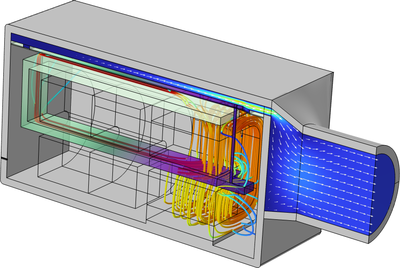
This is a full vibro-electroacoustic simulation of a balanced armature transducer (BAT or also known as a receiver in some industries) which is a high-performance miniature loudspeaker often used in hearing aids and other in-ear audio products such as earbuds. The model is set up and ... Read More
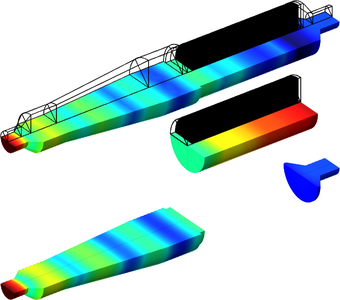
Diesel particulate filters (DPFs) are designed to remove and filter soot (diesel particles) from the exhaust of diesel engine vehicles. The filters in such systems are typically structured with long, air-filled channels surrounded by a porous medium that retains the soot. Although the ... Read More
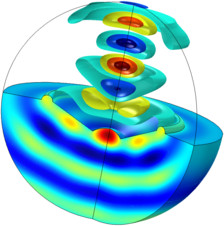
This is a model of a moving-coil loudspeaker where a lumped parameter analogy represents the behavior of the electrical and mechanical speaker components. The Thiele-Small parameters (small-signal parameters) serve as input to the lumped model, which is represented by an Electric Circuit ... Read More
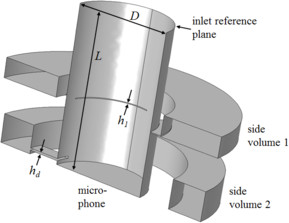
This is the model of an occluded ear canal simulator (a generic 711 coupler). Besides certain details the geometry corresponds to the Brüel & Kjær Ear Simulator Type 4157. The real life couplers are used for simulating the acoustics of a standardized human ear canal and can be used ... Read More
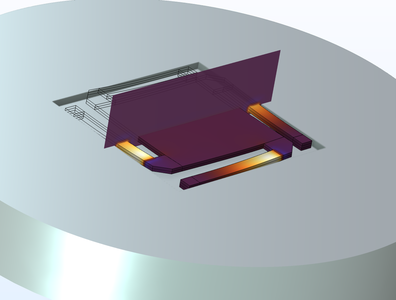
This model analyzes the operation of a micromirror in air and the effects of thermoviscous damping on the vibration response. The model includes thermal losses in the structure as well as thermoviscous acoustic phenomena. The model couples the Thermoelasticity multiphysics interface to ... Read More
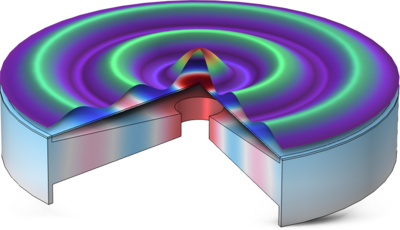
This example of a simple axisymmetric condenser microphone includes all the relevant physics and determines the microphone sensitivity as well as microphone capacitance for the specific simplified microphone geometry and material parameters. It solves a fully coupled multiphysics model ... Read More
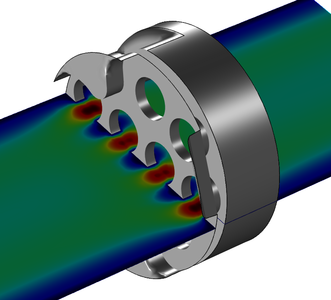
In this tutorial, the acoustic properties of a wax guard are analyzed. A wax guard is a small perforated mesh used to protect the receiver (the miniature loudspeaker in a hearing aid) used for receiver-in-the-ear (RITE) or receiver-in-canal (RIC) hearing aids. Because of the very small ... Read More
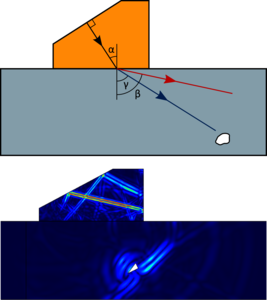
Angle beam ultrasonic units are used for nondestructive testing (NDT) of solid objects, such as metal pipes. They are especially useful for detecting flaws in and around welding areas, such as pores, small cracks, lack of fusion, etc. Angle beam NDT is often used where the straight beam ... Read More
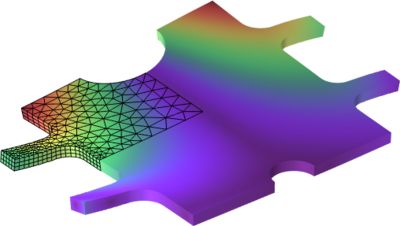
In this tutorial, the vibrational behavior of a small aluminum plate with four waveguide structures is analyzed. This is an example of a structural component located in a device where elastic waves are propagating, like a smart speaker, an electric motor, or a MEMS device. The plate can ... Read More
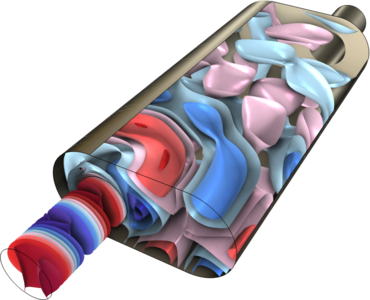
This example describes the pressure wave propagation in a muffler for an internal combustion engine. This example shows how to analyze both inductive and resistive damping in a muffler as well as the use of port boundary conditions. Read More


