
The Application Gallery features COMSOL Multiphysics® tutorial and demo app files pertinent to the electrical, structural, acoustics, fluid, heat, and chemical disciplines. You can use these examples as a starting point for your own simulation work by downloading the tutorial model or demo app file and its accompanying instructions.
Search for tutorials and apps relevant to your area of expertise via the Quick Search feature. Note that many of the examples featured here can also be accessed via the Application Libraries that are built into the COMSOL Multiphysics® software and available from the File menu.
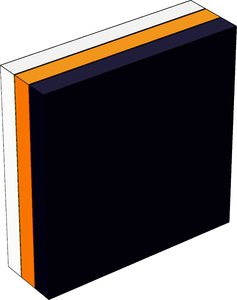
When radiation occurs across a very narrow gap this is often well-approximated as radiation between infinite parallel plates. This model considers three aluminum plates separated by narrow air gaps. The model compares the classical approach, based on the Surface-to-Surface Radiation ... Read More

Nucleate boiling occurs when a liquid is heated by a source hotter than the saturated fluid temperature but with a heat flux below the critical heat flux. In this regime, high heat flux are possible due to the evaporation of the liquid. This model aims to demonstrate the calculation of ... Read More
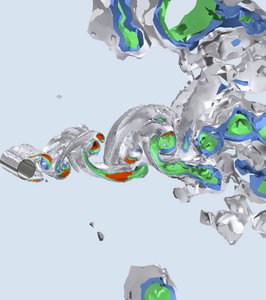
The model compare the two RANS models SST and SST-SAS for turbulent flow around a cylinder. The SST-SAS model resolve more transversal turbulent structures compared to the SST model. Read More

Opto-acoustophoresis is a term used to describe the interplay between acoustics and optical fields. In most cases (including this) the optical field is heating up the material and therefore affecting the acoustic field. In this example of an acoustic trap a set of particle are trapped ... Read More
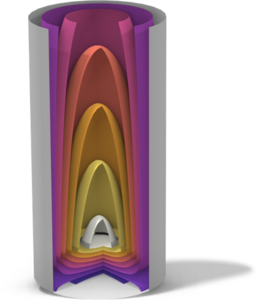
Inside of a combustion chamber, the gas mix behaves as a non-gray medium. Such media require a lot of data and computational resources to get results across the whole spectrum. The Weighted Sum of Gray Gases Model (WSGG) proposes an approach to model the non-gray gas mix as a sum of ... Read More
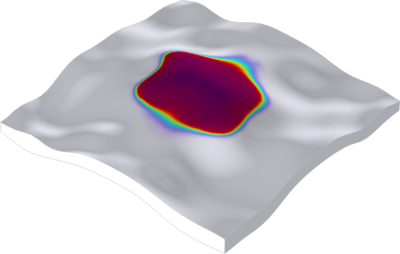
Modeling and simulation is useful for evaluating the feasibility of storing hydrogen underground. In this example of a geological formation, hydrogen is injected through an injection well at a rate of 1 kg/s over a period of 2 years, until it is ready to be extracted and discharged ... Read More
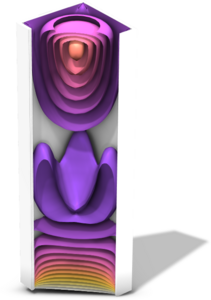
A smoke exhaust duct in a building is analyzed. Radiation of a non-gray gas is accounted for with a Radiation in Participating Media interface and the Weighted Sum of Gray Gases Model (WSGG). The smoke exhaust duct consists of 25 mm plaster walls. Building codes require that the walls ... Read More

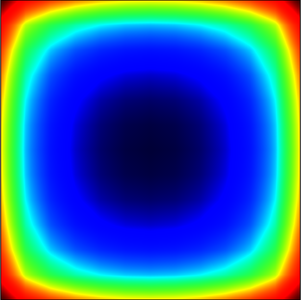
This model is used on "Heat Transfer with Radiation in Participating Media and the Discrete Ordinates Method" to compare quadrature sets used in the method of discrete ordinates. The reference analytical solution of incident irradiation is obtained with 256 discrete directions. Errors in ... Read More
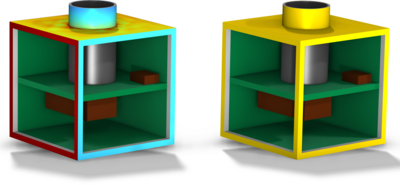
This model aims to demonstrate how a multilayer insulation can affect the temperature distribution of a satellite orbiting around the Earth. It is based on the Spacecraft Thermal Analysis model available in the Application Library. Read More


