
The Application Gallery features COMSOL Multiphysics® tutorial and demo app files pertinent to the electrical, structural, acoustics, fluid, heat, and chemical disciplines. You can use these examples as a starting point for your own simulation work by downloading the tutorial model or demo app file and its accompanying instructions.
Search for tutorials and apps relevant to your area of expertise via the Quick Search feature. Note that many of the examples featured here can also be accessed via the Application Libraries that are built into the COMSOL Multiphysics® software and available from the File menu.

Turbulent flow, SSG-LRR interface is used to analyze fully developed turbulent flow in an axially rotating pipe and in a swirling jet emanating from such a pipe. The resulting flow pattern in the pipe is characterized by slower-than-solid-body rotation. Axial velocity of the swirling jet ... Read More
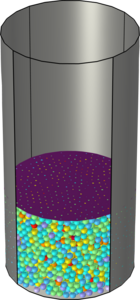
Grain compaction is the process by which granular material is placed in a container and compressed with an external pressure. It can be used to increase the packing density and alter the mechanical and thermal properties of the resultant samples, and it is thus a crucial step in many ... Read More
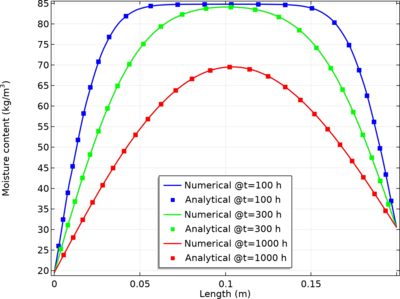
This case shows how to simulate moisture transport in a homogeneous wall under isothermal conditions. With this assumption, an analytical solution can be calculated. The homogeneous layer is initialized in moisture balance. At the beginning of the simulation, the relative humidity of ... Read More
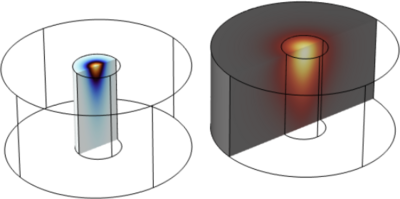
This model demonstrates how to couple the Radiative Beam in Absorbing Media interface to the Radiation in Absorbing-Scattering Media interface. To learn more about this model, see our accompanying blog post “Modeling Absorption and Scattering of Collimated Light”. Read More
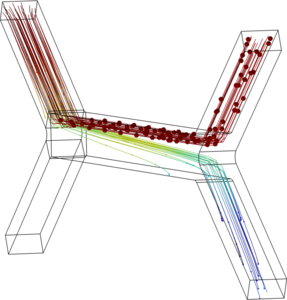
This model demonstrates continuous magnetophoretic separation of particles in a 3D microfluidic Y-channel using a permanent magnet. Separation is achieved through the balance between the magnetophoretic force and hydrodynamic drag. Read More
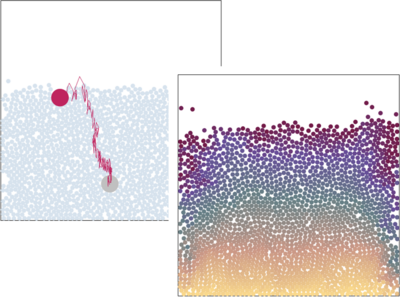
Formally known as size separation in vibrated granular materials, the Brazil nut effect (BNE) (and sometimes the Muesli effect) is a phenomenon that causes large grains to separate from small ones and rise to the top of a granular bed under vibrations. This phenomenon can be studied ... Read More
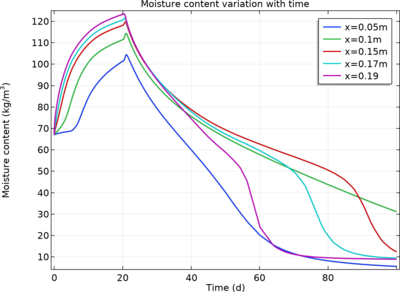
This tutorial shows how to simulate coupled heat and moisture transport in a wall. The wall is modeled considering an air flow between interior and exterior varying with time. The 1D model is the third benchmark test defined in HAMSTAD-WP2 Modeling for the validation of numerical ... Read More
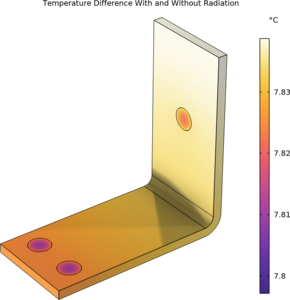
This model computes an electromagnetic-heated busbar with surface-to-surface radiation and compares the results with the busbar model without radiation. The surface emissivity of copper is varied between 0.1 (blank material), 0.3 (partially oxidized), and 0.7 (heavily oxidized). A more ... Read More
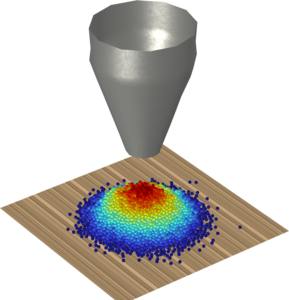
This example uses the Granular Flow interface to model the fixed funnel method for calculating the angle of repose, where a funnel is kept at a fixed height. The funnel is first filled with grains which are subsequently released and collected as a heap. The resultant heap is then ... Read More

The TSSG process, namely Top-Seeded Solution Growth, is a method used to grow SiC single crystals. It has the advantages of lower growth temperature and high crystal quality. This model introduces the simulation method of the TSSG process, obtains the temperature distribution of the ... Read More


