
The Application Gallery features COMSOL Multiphysics® tutorial and demo app files pertinent to the electrical, structural, acoustics, fluid, heat, and chemical disciplines. You can use these examples as a starting point for your own simulation work by downloading the tutorial model or demo app file and its accompanying instructions.
Search for tutorials and apps relevant to your area of expertise via the Quick Search feature. Note that many of the examples featured here can also be accessed via the Application Libraries that are built into the COMSOL Multiphysics® software and available from the File menu.
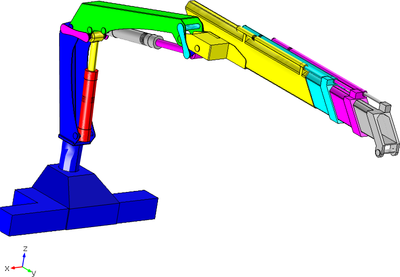
Many trucks are equipped with cranes for load handling. Such cranes have a number of hydraulic cylinders, controlling the motion, and several mechanisms. The cylinders and mechanisms that make up the crane are subjected to large forces when handling heavy loads. In order to determine ... Read More
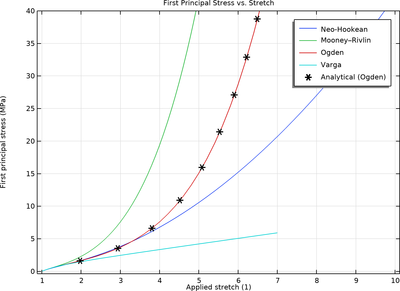
This model demonstrates the inflation of a rubber balloon with four different hyperelastic material models. The results are compared with the analytical solution for a thin-walled, spherical vessel. Controlling the inflation of hyperelastic balloons is important in clinical ... Read More
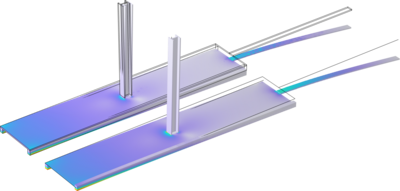
Many engineering structures consist of thin and slender components, where a full solid model will result in many extremely small elements. For such structures, it is much more efficient to use shell or beam elements. In this tutorial and verification model, it is shown how to connect ... Read More
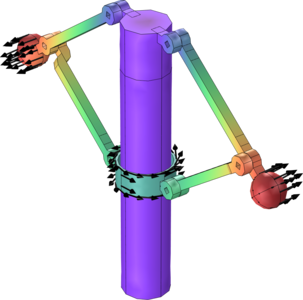
A centrifugal governor is used to control the speed of rotating machinery. One of the most common applications is in controlling the RPM of an engine by regulating the fuel supply. This model illustrates the functioning of a spring loaded centrifugal governor. The dynamics of the ... Read More
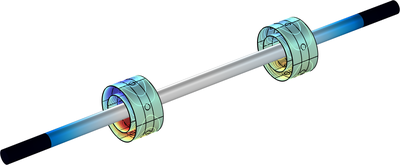
In this model, a turbocharger supported on two floating ring bearings is studied. The film forces on the ring cause it to rotate within the bearing. In steady state, the ring rotates at a constant angular speed and the torque on the ring due to the inner and outer films are balanced. ... Read More
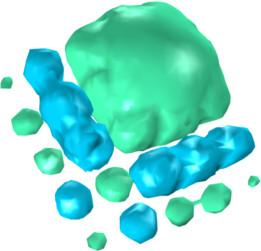
The Bessel panel is a way to arrange a number of loudspeakers so that the angular sound distribution resembles that of a single speaker. This model combines five Bessel panels in the same pattern to approximate a purely radial sound field. The speakers are driven with different ... Read More
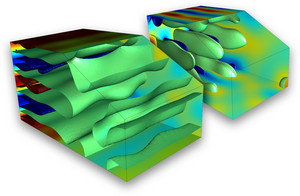
Sound is generated by a point source located in the wall of this test bench car interior. The sound pressure level response at a point of measurement is investigated for a range of frequencies and four different mesh resolutions. The model is first solved with the default direct solvers. ... Read More
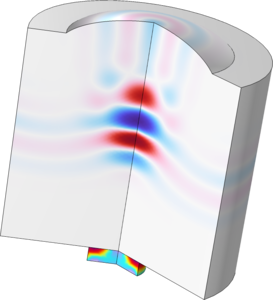
Piezoelectric devices are widely used as sources to generate sound waves or receivers to detect acoustic signals. In applications such as ultrasound imaging and nondestructive testing, the same transducer can be used as a transmitter to send a source signal and receiver to detect ... Read More


