
The Application Gallery features COMSOL Multiphysics® tutorial and demo app files pertinent to the electrical, structural, acoustics, fluid, heat, and chemical disciplines. You can use these examples as a starting point for your own simulation work by downloading the tutorial model or demo app file and its accompanying instructions.
Search for tutorials and apps relevant to your area of expertise via the Quick Search feature. Note that many of the examples featured here can also be accessed via the Application Libraries that are built into the COMSOL Multiphysics® software and available from the File menu.
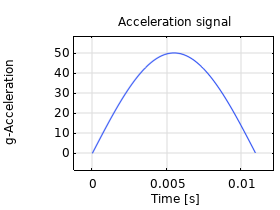
The purpose of this application is to generate response spectra from a time history which can consist of either measured data on a file, or an analytical function. Primarily, the target is to provide input to a response spectrum analysis. The graphs can, however, also be used to ... Read More
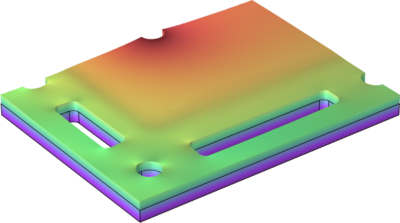
A fuel cell stack operates at temperatures just below 100 °C, which means that it has to be heated at start-up. The fuel cell stack consists of unit cell of anode, membrane, and cathode connected in series through bipolar plates. This study presents a model that couples the thermal and ... Read More
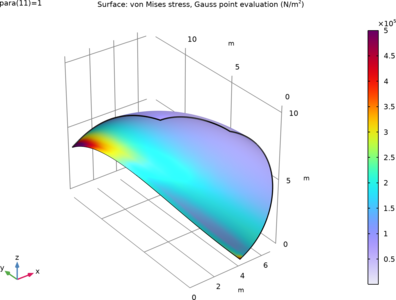
This example studies the deformation of a hemispherical shell, where the loads cause significant geometric nonlinearity. The maximum deflections are more than two magnitudes larger than the thickness of the shell. The problem is a standard benchmark, used for testing shell formulations ... Read More
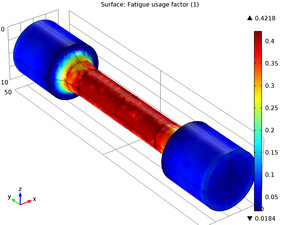
A benchmark model for the fatigue module. A cylindrical test is subjected to non-proportional loading. Three stress based models: Findley, Matake, Normal stress, are compared to analytical values and to each other. The non-smooth behavior of the Matake model is captured and discussed. Read More
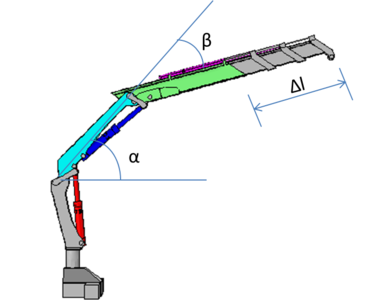
Many trucks are equipped with cranes for handling loads. These cranes use hydraulic cylinders to control the motion of the crane, and the cylinders and other components are subjected to large forces when handling heavy loads. To determine the load-carrying capacity of the crane, these ... Read More
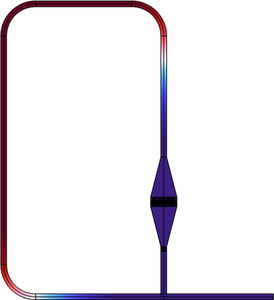
The models simulate the working mechanism of traveling wave thermoacoustic engines. Similary to the standing wave engines, the traveling wave engines make use of the coupling between the fluid motion and the temperature change experienced by the fluid to generate acoustic energy. ... Read More

Walking instability due to the nonuniform distribution of clothes is a common problem in lightweight portable washing machines. This problem is more severe in horizontal-axis washing machines, which are widely used because of their high efficiency despite their higher manufacturing ... Read More
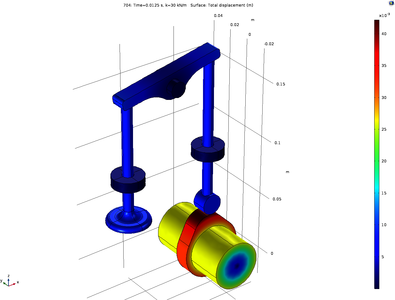
In this example, a spring-loaded valve-opening mechanism consisting of a rocker arm and a radial cam is studied. All of the system components are modeled as rigid and are connected through prismatic, hinge, and slot joints. The cam-follower connection as well as other joint connections ... Read More


