
The Application Gallery features COMSOL Multiphysics® tutorial and demo app files pertinent to the electrical, structural, acoustics, fluid, heat, and chemical disciplines. You can use these examples as a starting point for your own simulation work by downloading the tutorial model or demo app file and its accompanying instructions.
Search for tutorials and apps relevant to your area of expertise via the Quick Search feature. Note that many of the examples featured here can also be accessed via the Application Libraries that are built into the COMSOL Multiphysics® software and available from the File menu.
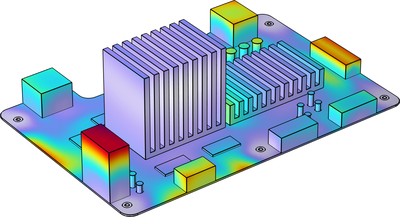
In this example, a random vibration test of electronic equipment is simulated. Three analyses are performed, one for acceleration in each global direction. Accelerations in the components and forces in clamping bolts are evaluated. Read More
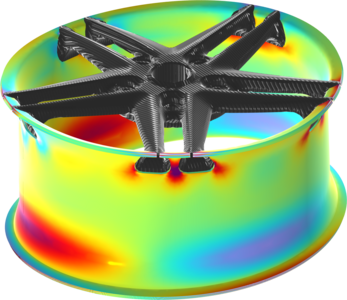
Nowadays, there is a trend toward manufacturing wheel rims from composite materials instead of aluminum. The main motivation is to reduce unsprung mass, which improves dynamic response and can enhance acceleration, braking, and cornering performance. Carbon-fiber-reinforced polymer ... Read More
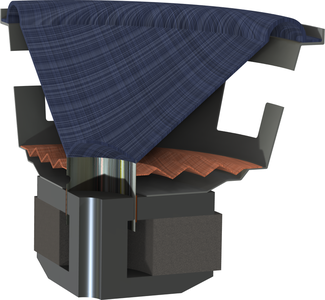
This tutorial shows how to best solve full 3D vibro-electroacoustic multiphysics models of loudspeakers. The model is based on a 3D representation of the existing 2D axisymmetric Application Library model loudspeaker_driver found in the software. The setup of the physics is essentially ... Read More
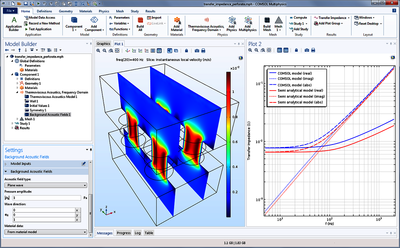
Perforates are plates with a distribution of small perforations or holes. They are used in muffler systems, sound absorbing panels, and in many other places as liners, where it is important to control attenuation precisely. As the perforations become smaller and smaller, viscous and ... Read More
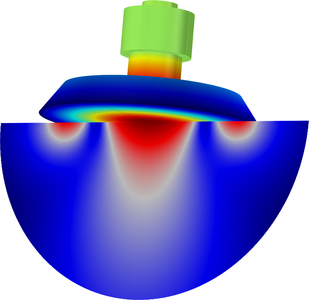
A tonpilz transducer is used for relatively low frequency, high power sound emission. It is one of the popular transducer configurations for SONAR applications. The transducer consists of piezoceramic rings stacked between a head mass and a tail mass which are connected by a central ... Read More

In this model, the scattering coefficient of a Schroeder diffuser is calculated. This coefficient can then be used as input to express boundary conditions in typical room acoustic simulations. The effect of periodicity is also investigated by studying the responses from different ... Read More
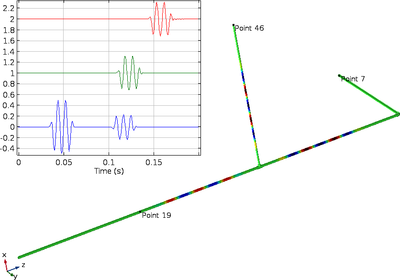
This tutorial shows how to model the propagation of acoustic waves in large pipe systems by coupling the Pipe Acoustics interface to the Pressure Acoustics interface. The tutorial is set up in both the time domain and the frequency domain. 1D pipe acoustics is used to model the ... Read More
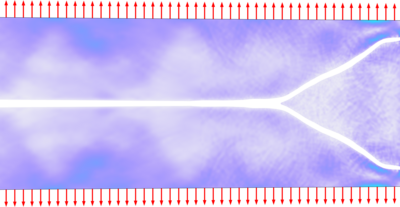
In this example, a benchmark problem in dynamic fracture of brittle materials is analyzed using the AT1 phase-field damage model. An instantaneous tensile load is applied to a planar tension specimen with a pre-existing crack. Initially, the crack propagates perpendicular to the loading ... Read More


