
The Application Gallery features COMSOL Multiphysics® tutorial and demo app files pertinent to the electrical, structural, acoustics, fluid, heat, and chemical disciplines. You can use these examples as a starting point for your own simulation work by downloading the tutorial model or demo app file and its accompanying instructions.
Search for tutorials and apps relevant to your area of expertise via the Quick Search feature. Note that many of the examples featured here can also be accessed via the Application Libraries that are built into the COMSOL Multiphysics® software and available from the File menu.
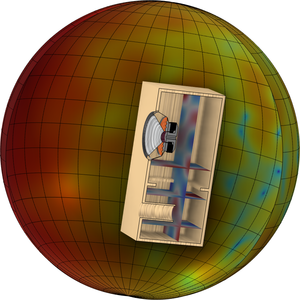
This tutorial models the acoustic behavior of a loudspeaker driver mounted in a bass reflex enclosure. The enclosure, sometimes called the cabinet, alters substantially the sensitivity and radiation characteristics of the loudspeaker and it is why it is usually considered part of the ... Read More
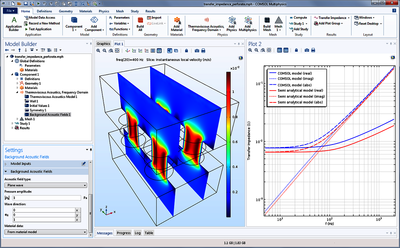
Perforates are plates with a distribution of small perforations or holes. They are used in muffler systems, sound absorbing panels, and in many other places as liners, where it is important to control attenuation precisely. As the perforations become smaller and smaller, viscous and ... Read More

This example illustrates the principle of electrochemical polishing. The simplified 2D model geometry consists of two electrodes and an intermediate electrolyte domain The positive electrode has a protrusion, representing a surface defect. The purpose of the model is to examine how this ... Read More
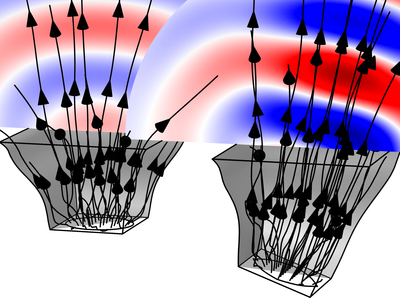
This model demonstrates how to use the Control Function feature to perform shape optimization on a rectangular horn for an improved on axis response. The results of the initial design are exported to a new component via a Filter dataset. Further, the off-axis spatial response is improved ... Read More
This app demonstrates the following: Playing a sound at a specific computed frequency Selecting different materials from a combo box Visualizing material appearance, color, and texture Choice of three different user interface layouts for computer, tablet, or smartphone Custom ... Read More
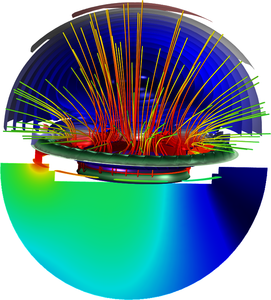
This model analyzes the electromagnetic, mechanical, and acoustical characteristics of the OWS-1943T-8CP (discontinued) speaker. Beside certain details, the geometry, material properties, and measurements are copyright by Ole Wolff. Starting from the geometry of the speaker, an ... Read More
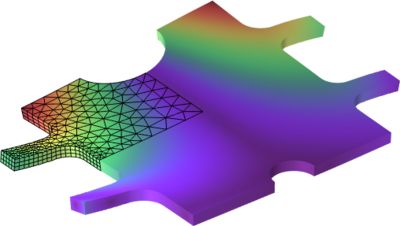
In this tutorial, the vibrational behavior of a small aluminum plate with four waveguide structures is analyzed. This is an example of a structural component located in a device where elastic waves are propagating, like a smart speaker, an electric motor, or a MEMS device. The plate can ... Read More
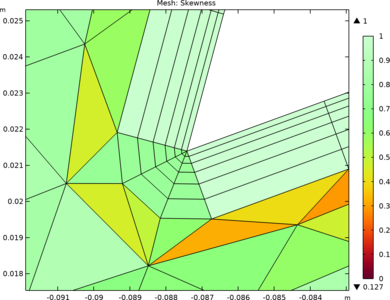
Tutorials in this series deal with creating and manipulation of boundary layer meshes. In these tutorials you will learn how to set up a boundary layer mesh and modify the settings for an automatically created boundary layer mesh. For physics-controlled meshing a boundary layer mesh is ... Read More
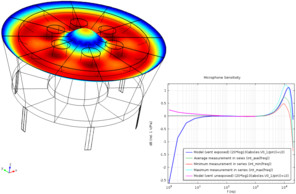
This is a model of the Brüel and Kjær 4134 (BK 4134) condenser microphone. The geometry and material parameters are those of the actual microphone. The modeled sensitivity level is compared to measurements performed on an actual microphone and shows good agreement. The membrane ... Read More
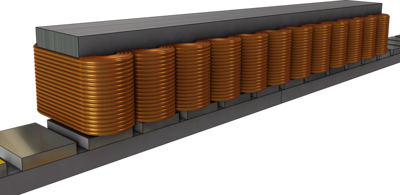
Linear motors are used in many applications in need of translational motion. Typical characteristics of linear motor designs are high precision or quick acceleration. This model investigates a synchronous motor with three-phase winding on the stationary part and permanent magnets on the ... Read More


