
The Application Gallery features COMSOL Multiphysics® tutorial and demo app files pertinent to the electrical, structural, acoustics, fluid, heat, and chemical disciplines. You can use these examples as a starting point for your own simulation work by downloading the tutorial model or demo app file and its accompanying instructions.
Search for tutorials and apps relevant to your area of expertise via the Quick Search feature. Note that many of the examples featured here can also be accessed via the Application Libraries that are built into the COMSOL Multiphysics® software and available from the File menu.
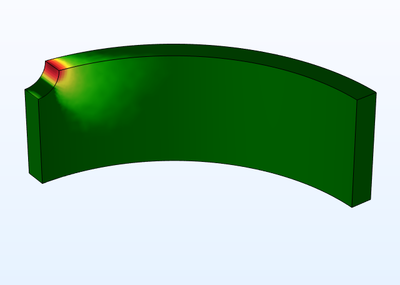
A load carrying component of a structure is subjected to multi-axial cyclic loading during which localized yielding of the material occurs. In this model you perform a low cycle fatigue analysis of the part based on the Smith-Watson-Topper (SWT) model. Due to localized yielding, you ... Read More
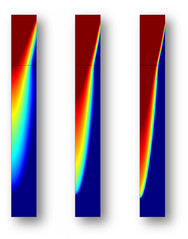
This example is a model of a continuous casting process. Liquid metal is poured into a mold of uniform cross section. The outside of the mold is cooled and the metal solidifies as it flows through. When the metal leaves the mold, it is completely solidified on the outside, but still ... Read More
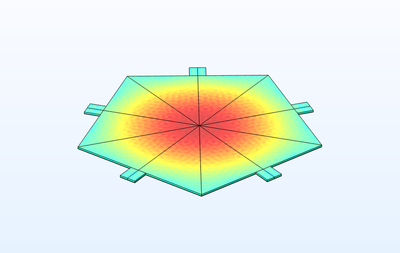
This tutorial demonstrates how an electrical circuit model of a MEMS resonator can be derived using the Parameter Estimation feature. The model is a modified Butterworth-Van Dyke circuit created using the Electrical Circuit interface and represents a Thin-Film Bulk Acoustic Resonator ... Read More
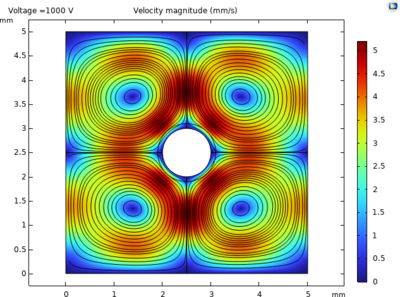
This model simulates the electrohydrodynamic (EHD) flow of a dielectric liquid around a wire electrode positioned between two parallel flat-plate electrodes. The ion transport is described using the Poisson–Nernst–Planck equations, while fluid motion is governed by the Navier–Stokes ... Read More
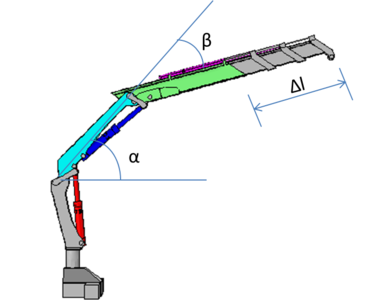
This app demonstrates the following: Using the knob form object Updating the geometry by rotating a knob Provides info if the results are above or below certain critical values Many trucks are equipped with cranes for handling loads and such cranes have a number of hydraulic ... Read More
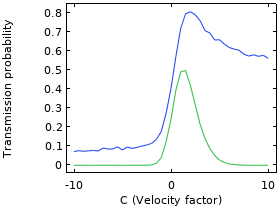
The Monte Carlo simulation of flow in a turbomolecular pump can be greatly simplified if the mean radius of the blades is much greater than the spacing between them. Under these conditions, the rotating blades of the pump can be approximated as an infinite row of blades having only ... Read More
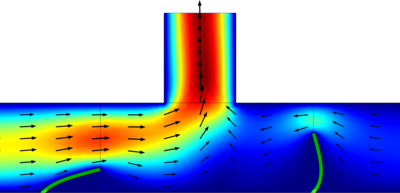
Micropumps are key components of microfluidic systems with applications ranging from biological fluid handling to microelectronic cooling. This model simulates the mechanism of a valveless micropump, that is designed to be effective at low Reynolds numbers, overcoming hydrodynamic ... Read More

This example uses the Granular Flow interface to model the formation of the grain heap and then its subsequent spreading using a cylindrical roller. The roller has a combined rotational and translational motion. The resulting powder bed is then analyzed to determine its quality based on ... Read More
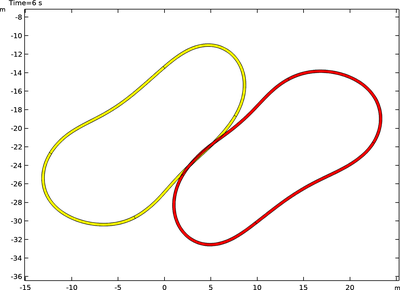
In this conceptual example, the soft impact between two elastic rings is modeled using the Solid Mechanics and Shell interfaces. One of the rings is given an initial velocity to initiate the impact event. Both rings are unconstrained and not subjected to any external forces. Contact is ... Read More
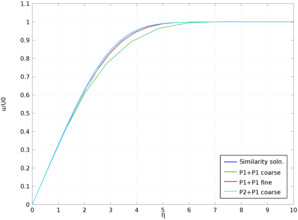
The incompressible boundary layer on a flat plate in the absence of a pressure gradient is usually referred to as the Blasius boundary layer. The steady, laminar boundary layer developing downstream of the leading edge eventually becomes unstable to Tollmien-Schlichting waves and finally ... Read More


