
The Application Gallery features COMSOL Multiphysics® tutorial and demo app files pertinent to the electrical, structural, acoustics, fluid, heat, and chemical disciplines. You can use these examples as a starting point for your own simulation work by downloading the tutorial model or demo app file and its accompanying instructions.
Search for tutorials and apps relevant to your area of expertise via the Quick Search feature. Note that many of the examples featured here can also be accessed via the Application Libraries that are built into the COMSOL Multiphysics® software and available from the File menu.
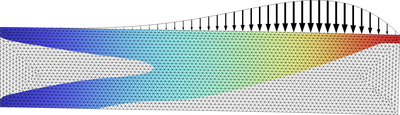
The mass of an aluminum beam is minimized subject to a displacement constraint and a distributed load. The problem is solved using topology optimization with milling constraints. Read More

The thin low permittivity gap boundary condition is meant to approximate a thin layer of material with low relative permittivity compared to its surroundings. This boundary condition is available for electrostatic field modeling. This example compares the thin low permittivity gap ... Read More
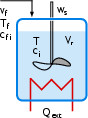
As reactant monomer converts into polymer chains, the density of the reacting mixture often changes notably. In this example you will look at how this effect impacts the total production of polymer in a process. The liquid phase polymerization takes place in a semibatch reactor, where ... Read More

This model of a two-story house can be used to examine a contaminant leak and the subsequent contaminant dispersion that occurs due to convection and diffusion. Airflow and recirculation within the home are dependent on vent placement, and flow velocity may also vary at each vent. ... Read More
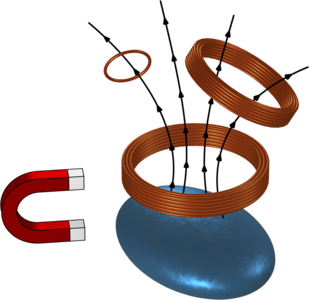
Differential inductance is relevant when a low-frequency electromagnetic system includes magnets, nonlinear magnetic materials, and moving parts. These models present examples of computing the differential inductance and using these within simplified lumped models. To learn more about ... Read More
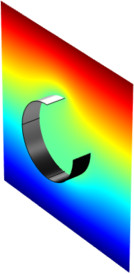
Many applications involve simulating the electromagnetic behavior of relatively thin material in voluminous domains. To save computer memory and processing time, the thin materials can be treated differently by resolving them with 3D meshes. Here, the modeling domain is a box filled ... Read More
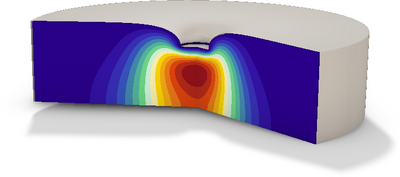
This example demonstrates how to use the Poroelasticity multiphysics coupling between the Solid Mechanics and Darcy's Law interfaces to model linear biphasic poroviscoelastic behavior of soft biological tissues. The implementation is verified using two numerical benchmarks from the ... Read More
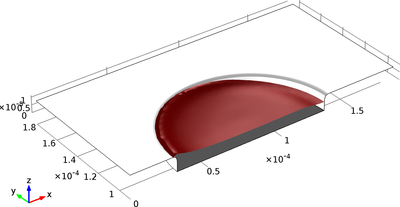
This model simulates the shape evolution of a microconnector bump over time as copper deposits on an electrode surface. Transport of cupric ions in the electrolyte occurs by convection and diffusion. The electrode kinetics are described by a concentration dependent Butler-Volmer ... Read More
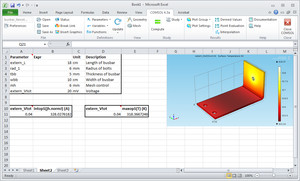
Tutorial model that demonstrates how to work with COMSOL models in Excel, including loading and saving files, updating model parameters, solving, and retrieving results. Read More
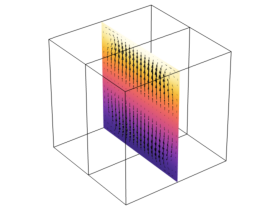
This example studies the stationary state of free convection in a cavity filled with water and bounded by two vertical plates. To generate the buoyancy flow, the plates are heated at different temperatures, bringing the regime close to the transition between laminar and turbulent. To ... Read More


