
The Application Gallery features COMSOL Multiphysics® tutorial and demo app files pertinent to the electrical, structural, acoustics, fluid, heat, and chemical disciplines. You can use these examples as a starting point for your own simulation work by downloading the tutorial model or demo app file and its accompanying instructions.
Search for tutorials and apps relevant to your area of expertise via the Quick Search feature. Note that many of the examples featured here can also be accessed via the Application Libraries that are built into the COMSOL Multiphysics® software and available from the File menu.
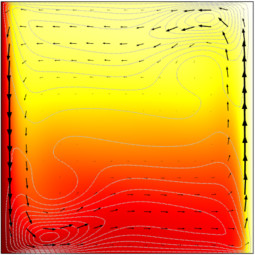
This model couples the Navier Stokes equations and the heat transfer equations to examine density driven flow of free fluids. Here the fluid is in a square cavity with a heated wall. The buoyancy force is a Boussinesq term added to the Navier-Stokes equations. The equation is ... Read More
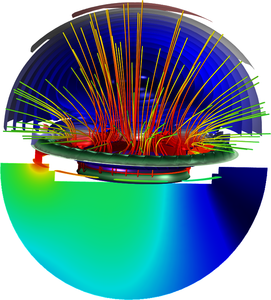
This model analyzes the electromagnetic, mechanical, and acoustical characteristics of the OWS-1943T-8CP (discontinued) speaker. Beside certain details, the geometry, material properties, and measurements are copyright by Ole Wolff. Starting from the geometry of the speaker, an ... Read More
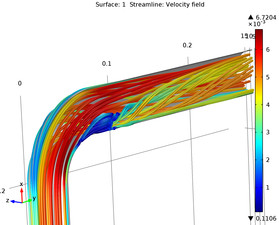
This example models the flow in a 90-degree pipe elbow. The flow is simulated using the k-omega turbulence model. The result is compared to engineering correlations. Read More
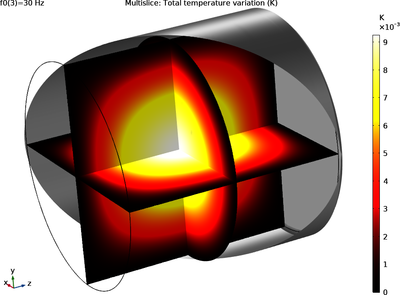
When high-fidelity measurement microphones are calibrated, a pressure reciprocity calibration method is used. During calibration, two microphones are connected at each end of a closed cylindrical cavity. For the calibration procedure, it is important to understand the acoustic field ... Read More

In a lithium metal battery, lithium metal is deposited during charging on the negative electrode. Mass transport and ohmic effects in the electrolyte cause small protrusions on the metal surface to be subjected to accelerated growth during charging. In worst case scenarios, this leads to ... Read More
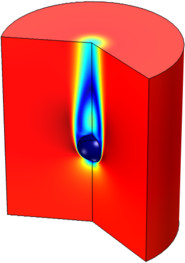
The first stop for polluted water entering a water work is normally a large tank, where large particles are left to settle. Generally, gravity settling is an economical method of separating particles. If the fluid in the tank is moving at a controlled low velocity, the particles can be ... Read More
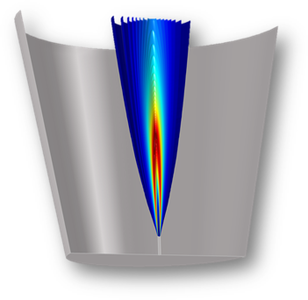
The model simulates non-premixed turbulent combustion of syngas (synthesis gas) in a simple round-jet burner. Syngas is a gas mixture, primarily composed of hydrogen, carbon monoxide and carbon dioxide. The name syngas relates to its use in creating synthetic natural gas. In the model, ... Read More
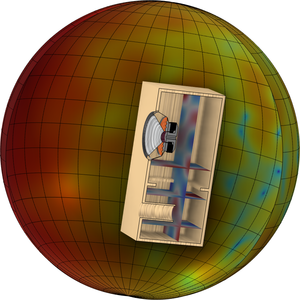
This tutorial models the acoustic behavior of a loudspeaker driver mounted in a bass reflex enclosure. The enclosure, sometimes called the cabinet, alters substantially the sensitivity and radiation characteristics of the loudspeaker and it is why it is usually considered part of the ... Read More
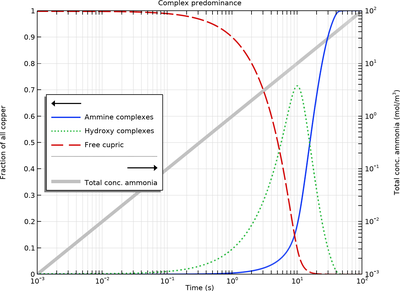
Cupric ions show a strong affinity to ammonia in aqueous solutions, forming strongly colored deep blue complexes. The relative amounts of the different ammine ligand complexes, with varying coordination numbers, are governed by the stability constants of the equilibria forming the ... Read More
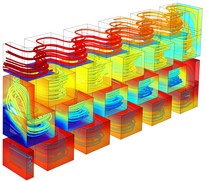
Plate reactors running under continuous conditions have emerged as candidates to replace batch reactors, primarily in fine chemicals and pharmaceuticals production. One of the advantages of the plate reactor design is that it allows for efficient temperature control of the reacting ... Read More


