
The Application Gallery features COMSOL Multiphysics® tutorial and demo app files pertinent to the electrical, structural, acoustics, fluid, heat, and chemical disciplines. You can use these examples as a starting point for your own simulation work by downloading the tutorial model or demo app file and its accompanying instructions.
Search for tutorials and apps relevant to your area of expertise via the Quick Search feature. Note that many of the examples featured here can also be accessed via the Application Libraries that are built into the COMSOL Multiphysics® software and available from the File menu.

This example exemplifies how to model a Koch snowflake using the Application Builder. A more detailed description of the phenomenon and the modeling process can be seen in the blog post "Using the Application Builder to Create a Koch Snowflake". Read More
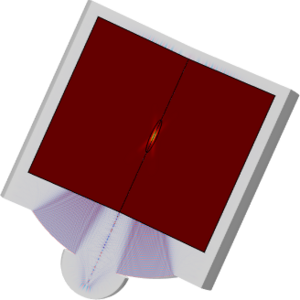
This model analyzes the uncertainty in focused ultrasound induced tissue heating. The material properties for the tissue mimicking material, including the uncertainty, are taken from the FDA Medical Device Development Tool: Tissue Mimicking Material (TMM) for Preclinical Acoustic ... Read More

An interesting question was raised in the 1950s by the mathematician Ernst Straus that, in an arbitrarily shaped empty room with side walls made of perfect mirrors, will a point light source always illuminate the whole room? This question was answered by the Nobel Prize-winning ... Read More
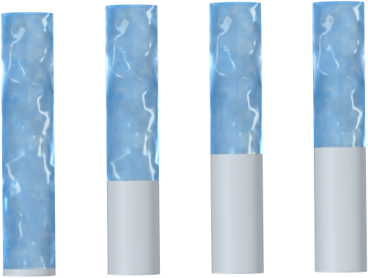
Phase change between a liquid or gas and a solid phase is an important phenomenon that is observed in various process across industries. When modelling such phase change, it can be important to account for the difference in density of the solid and fluid phase in order to ensure mass ... Read More

This example shows how to model isotropic volumetric growth and atrophy of soft biological tissues. The artery is represented by a cylinder that is stretched and compressed due to an applied axial load. As a result, the tissue undergoes growth and atrophy. Read More
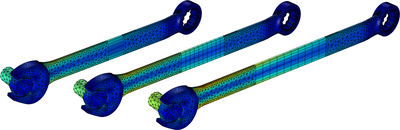
When you are working with foreign CAD or ECAD data, such as files in the STEP, GDS, or IGES file formats, or any of the other supported formats, you may think that you need to re-import a new CAD file and start your modeling over from scratch if you want to study a change in size or ... Read More
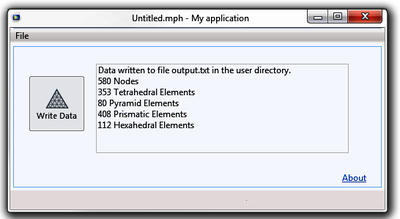
This example exemplifies how you can export the data from your mesh and results to a text file. A more detailed description of the phenomenon and the modeling process can be seen in the blog post "Exporting Meshes and Solutions Using the Application Builder". Read More
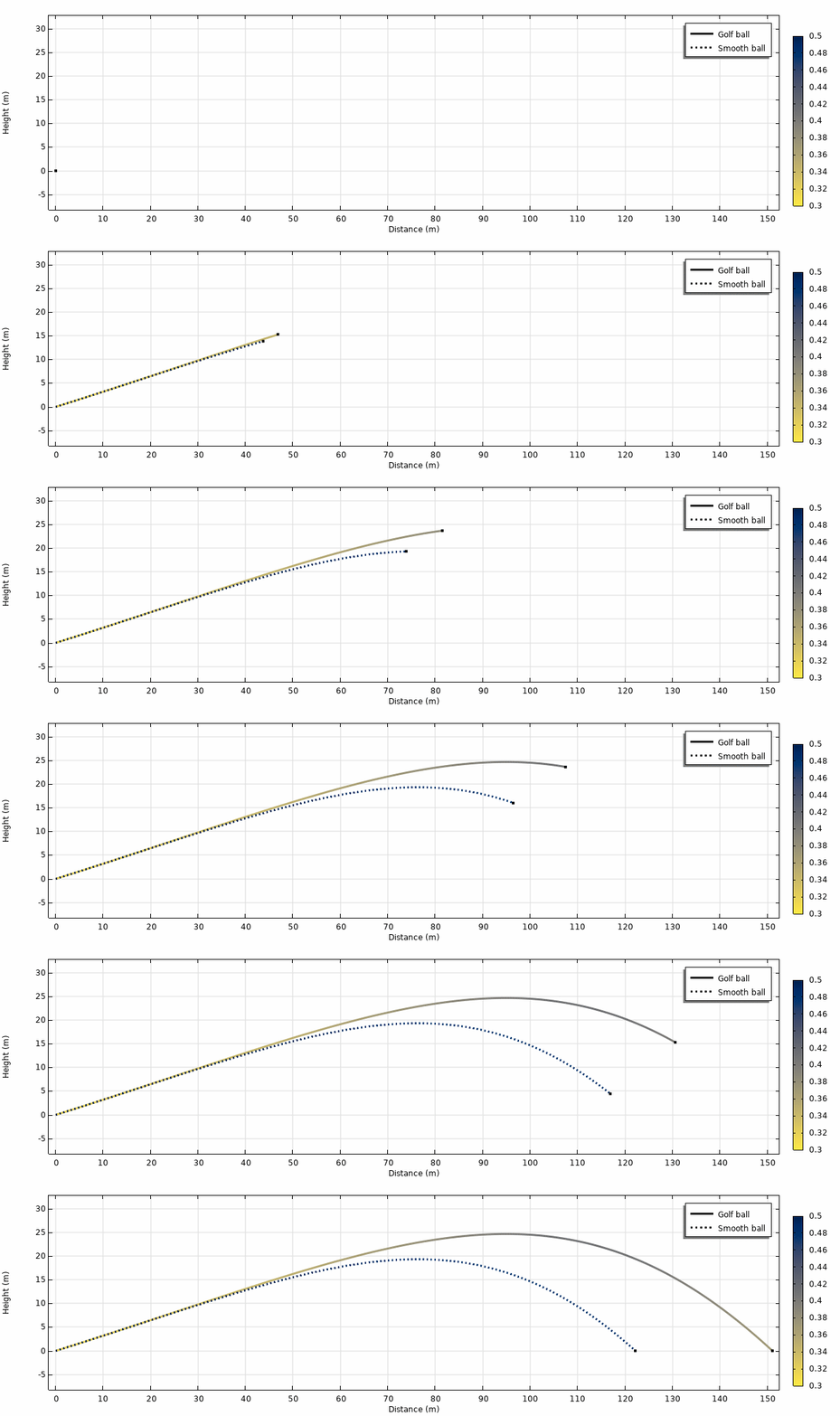
This model is used in the blog post "Why Do Golf Balls Have Dimples?". The trajectory of a golf ball is compared to the trajectory of a smooth ball using the Events interface and a system of ODEs in a 0D component. Read More

This app allows you to simulate the action potential in a cell's membrane using the Hodgkin-Huxley model. As it is presented in the form of a simulation app, you can change the input parameters for potential, conductance, and membrane capacitance to study their effects on the dynamics ... Read More
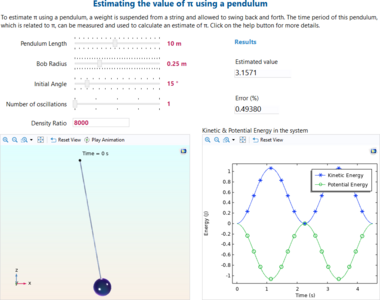
A simple way to estimate the value of π is by using a pendulum, whose oscillation period can be measured and used to calculate an approximation. This simulation app is based on a model that uses the <em>Multibody Dynamics</em> interface to describe the motion of a simple ... Read More


