
The Application Gallery features COMSOL Multiphysics® tutorial and demo app files pertinent to the electrical, structural, acoustics, fluid, heat, and chemical disciplines. You can use these examples as a starting point for your own simulation work by downloading the tutorial model or demo app file and its accompanying instructions.
Search for tutorials and apps relevant to your area of expertise via the Quick Search feature. Note that many of the examples featured here can also be accessed via the Application Libraries that are built into the COMSOL Multiphysics® software and available from the File menu.
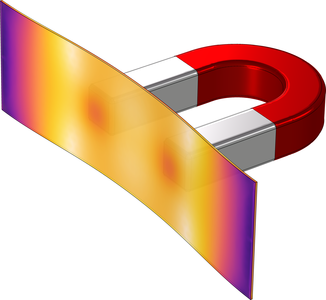
A strong permanent magnet is placed close to a clamped thin plate made of iron. The magnetic force causes the plate to be deflected. This example studies the plate's elastic deformation and stress. The deformation of the plate has an influence on the distribution of the magnetic field. ... Read More
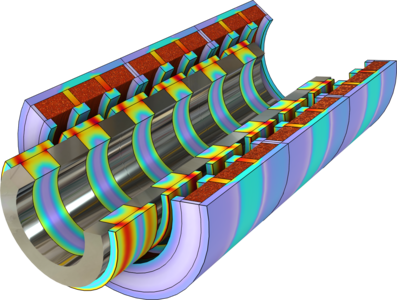
This tutorial shows how to model the tubular permanent magnet generator in 2D axisymmetry. The generator consists of a modular stationary stator and moving/oscillating slider. The stator is made of three-phase multiturn windings and an iron core. The slider is made of permanent magnets ... Read More
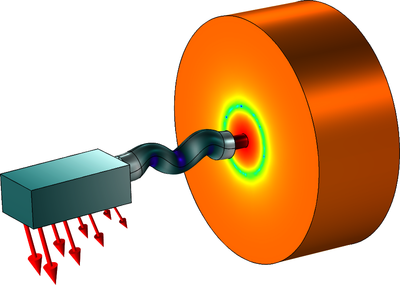
When simulations are involved in the development of mobile devices, consumer electronics, hearing aids, or headsets, it is necessary to consider how the transducers interact with the rest of the system. Here, we show an analysis of the interaction between a vibration isolation mounting ... Read More

This model simulates a simple three-dimensional axisymmetric Helmholtz resonator, a classic acoustics model of a resonating circuit with a known theoretical solution. The idealized version considered here consists of a tube and a closed volume in series which are exposed to a pulsatile ... Read More
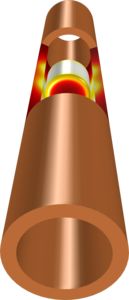
A cylindrical magnet falling through a copper tube induces eddy currents on the tube walls, which in turn, create a magnetic field that opposes the magnetic field of the magnet and induces a braking force that opposes the motion of the magnet. This model computes the velocity of the ... Read More

This model presents a study of the current density distribution in a solid oxide fuel cell (SOFC). The model includes the full coupling between the mass balances at the anode and cathode, the momentum balances in the gas channels, the gas flow in the porous electrodes, the balance of ... Read More
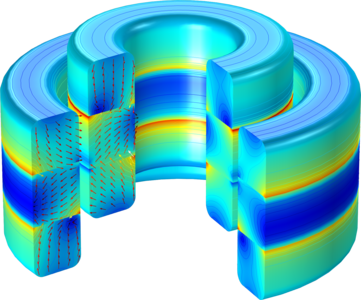
Permanent magnet bearings are used in turbomachinery, pumps, motors, generators, and flywheel energy storage systems, to mention a few application areas; contactless operation, low maintenance, and the ability to operate without lubrication are some key benefits compared to conventional ... Read More
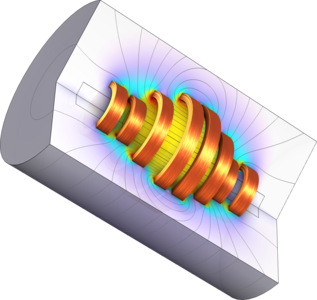
This example shows how to use the Optimization Module to find a coil geometry giving a uniform magnetic field on axis and minimal field near the axis ends. Read More
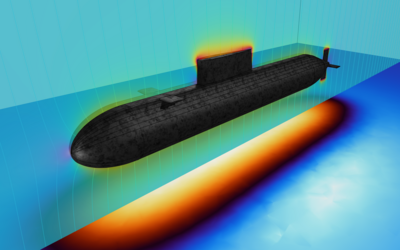
A vessel traveling on the surface or under water gives rise to detectable local disturbances in the Earth’s magnetic field. These disturbances can be used to trigger weapon systems. The magnetic signature of a ship can be reduced by generating a counteracting magnetic field of suitable ... Read More
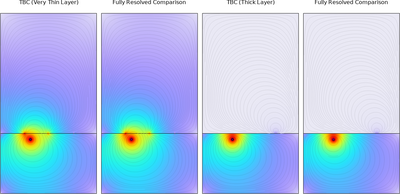
In electromagnetic simulations, such as transformers and converter stations, one often needs to include geometrically thin conductive layers. Explicitly meshing these thin layers can be computationally expensive and numerically challenging, especially when the layer thickness is much ... Read More


