
The Application Gallery features COMSOL Multiphysics® tutorial and demo app files pertinent to the electrical, structural, acoustics, fluid, heat, and chemical disciplines. You can use these examples as a starting point for your own simulation work by downloading the tutorial model or demo app file and its accompanying instructions.
Search for tutorials and apps relevant to your area of expertise via the Quick Search feature. Note that many of the examples featured here can also be accessed via the Application Libraries that are built into the COMSOL Multiphysics® software and available from the File menu.
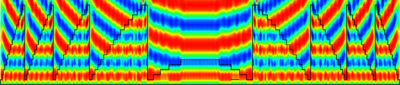
This model simulates a 16-level, first-order, focusing Fresnel lens with 50 µm diameter and 150 µm focal length. In one simulation, the Electromagnetic Waves, Frequency Domain interface computes the electric field in the Fresnel lens and the surrounding air domain extended to the focal ... Read More
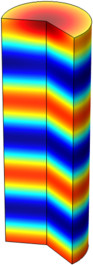
In this model, sound created by a vibrating piston radiates through a baffled pipe. The impedance is measured and then used in an impedance boundary condition that replaces the surrounding air domain. This technique can be employed to reduce solution time and memory usage for large ... Read More
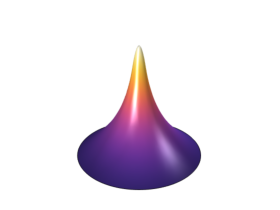
This classical verification model solves the steady state temperature distribution in a plan disk heated by a localized heat source at its center. It shows and compare different ways to define a heat source localized on a small domain by representing it either as a geometrical point or a ... Read More

Ultrahigh Molecular Weight (UHMW) Polyethylene is a material commonly employed in knee and hip joint replacements. The “small punch test” is designed to assess mechanical properties using very small samples, such that because of their size they can directly be explanted. This example ... Read More
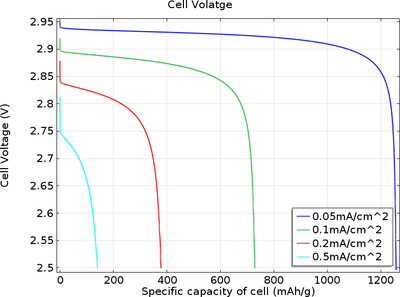
Rechargeable lithium-air batteries have recently attracted great interest mainly due to their high energy density. The theoretical value is about 11400 Wh/kg which is around 10 times greater than the lithium-ion batteries. In this tutorial, discharge of a lithium-air battery is ... Read More
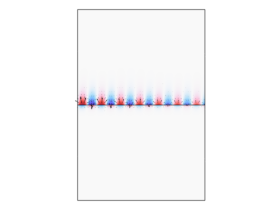
Electromagnetic waves that are confined to propagate along a surface, such as surface plasmon polaritons (SPPs), are of great research interest due to their potential applications in nanoscale manipulation of light. This model demonstrates how to set up a simulation of the propagation ... Read More
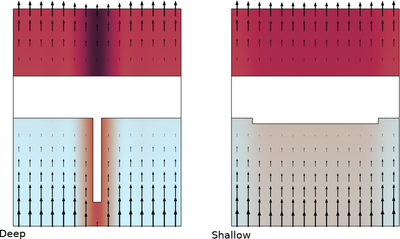
The copper current collector on negative graphite electrodes in lithium-ion batteries have been seen to dissolve at over discharge. This can be a safety concern as the dissolution damages the current collector irreversibly and dissolved copper ions can redeposit and form dendrites. ... Read More
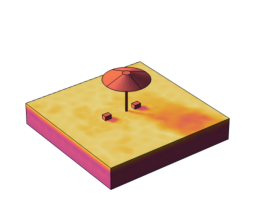
This tutorial model illustrates how to analyze the thermal effects of the sun as an external radiative source and considers wavelength-dependent surface emissivities. Specifically, the model features two coolers containing beverage cans that are exposed to ambient conditions and a beach ... Read More
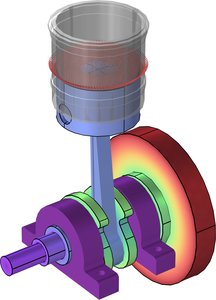
A single cylinder reciprocating engine supported on hydrodynamic bearings is studied. A starting torque is applied to bring the engine to required rpm. The loading torque is switched on once the engine picks up speed. After the start-up, the engine operates on its own driven by the ... Read More
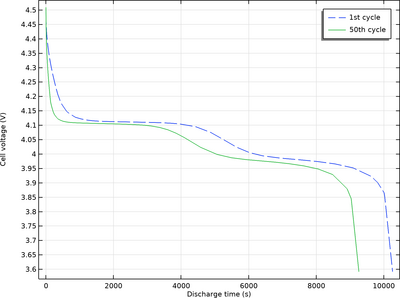
Some positive electrode materials are known to deteriorate in overcharged lithium-ion battery cells. Predominantly, manganese containing electrode materials such as LMO and NMC can loose capacity due to manganese dissolving from the materials at overcharge. This decomposition is a ... Read More


