
The Application Gallery features COMSOL Multiphysics® tutorial and demo app files pertinent to the electrical, structural, acoustics, fluid, heat, and chemical disciplines. You can use these examples as a starting point for your own simulation work by downloading the tutorial model or demo app file and its accompanying instructions.
Search for tutorials and apps relevant to your area of expertise via the Quick Search feature. Note that many of the examples featured here can also be accessed via the Application Libraries that are built into the COMSOL Multiphysics® software and available from the File menu.
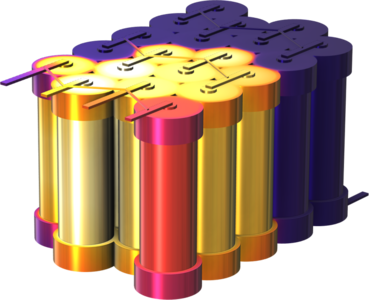
Due to abuse, such as internal or external short circuits or excessive heating, an individual battery cell may go into thermal runaway, during which the battery cell generates a significant amount of heat. If enough heat is transferred between adjacent cells during a thermal runaway ... Read More
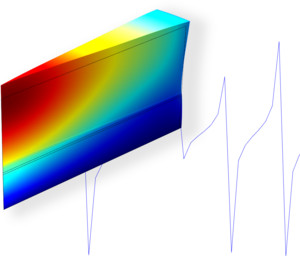
This example shows how to set up a piezoelectric transducer problem following the work of Y. Kagawa and T. Yamabuchi. The composite piezoelectric ultrasonic transducer has a cylindrical geometry that consists of a piezoceramic layer, two aluminum layers, and two adhesive layers. The ... Read More
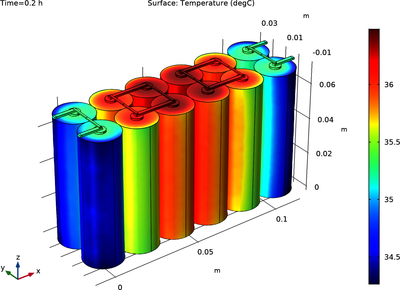
This example demonstrates how to model the temperature distribution in a battery pack during a 4C discharge. The pack is constructed by first coupling two cylindrical batteries in parallel. Six parallel-connected pairs are then connected in series to create the full pack. (This is also ... Read More
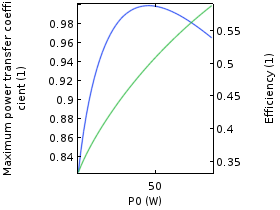
This tutorial drives a capacitively coupled plasma with an L-type matching network at high and low powers. At low power, where the harmonics in the current are low, prefect matching is obtained at the chosen power value. Sweeps over power, frequency, and pressure are performed and their ... Read More
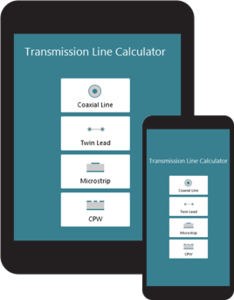
This app demonstrates the following: Creating apps for small screens such as smartphones User-interface navigation with a top menu typically used on websites Dynamically hiding forms using card stacks to minimize the space required by the app Changing appearance by using different ... Read More
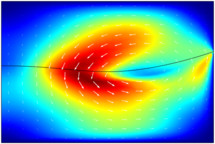
The contact angle of a two-fluid interface with a solid surface is determined by the balance of the forces at the contact point. In electrowetting the balance of forces at the contact point is modified by the application of a voltage between a conducting fluid and the solid surface. In ... Read More
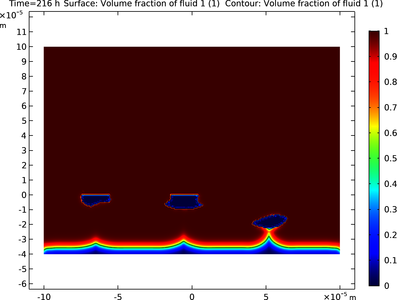
This example models galvanic corrosion between two different phases in a magnesium alloy for a representative cross-sectional microstructure configuration. The Level Set interface is used here to model dissolution of a constituent phase leading to topological changes. The electrode ... Read More
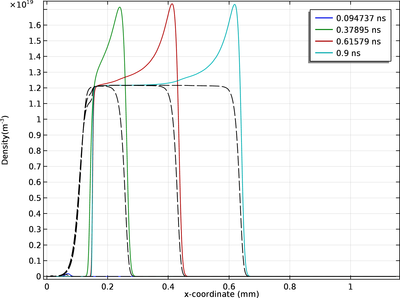
Streamers are transient filamentary electric discharges that can develop in a nonconducting background in the presence of an intense electric field. These discharges can attain high electron number density and consequently a high concentration of chemical active species that are relevant ... Read More
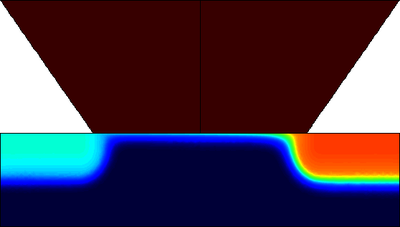
An ion-sensitive field-effect transistor (ISFET) is constructed by replacing the gate contact of a MOSFET with an electrolyte of interest. The concentration of a specific ionic species in the electrolyte can be determined by measuring the change in the gate voltage due to the interaction ... Read More
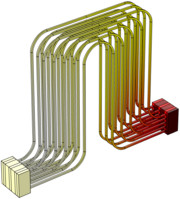
This model simulates a temperature profile in a number of cells and cooling fins in a liquid-cooled battery pack. The model solves in 3D and for an operational point during a load cycle. A full 1D electrochemical model for the lithium battery calculates the average heat source. Read More


