
The Application Gallery features COMSOL Multiphysics® tutorial and demo app files pertinent to the electrical, structural, acoustics, fluid, heat, and chemical disciplines. You can use these examples as a starting point for your own simulation work by downloading the tutorial model or demo app file and its accompanying instructions.
Search for tutorials and apps relevant to your area of expertise via the Quick Search feature. Note that many of the examples featured here can also be accessed via the Application Libraries that are built into the COMSOL Multiphysics® software and available from the File menu.
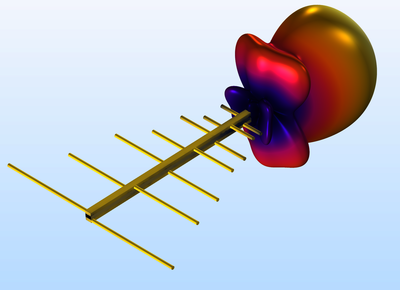
The shape of a log-periodic antenna resembles that of a Yagi-Uda antenna, but is composed of a coplanar array to achieve a wider bandwidth. It is also known as a wideband or frequency-independent antenna. All metallic parts are modeled using the perfect electric conductor (PEC) boundary ... Read More
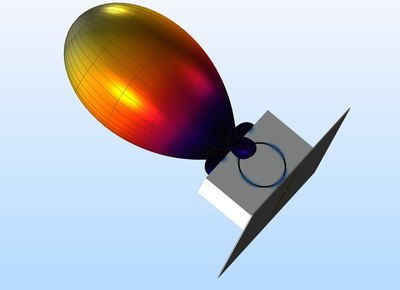
A dielectric resonator placed near a radiating element can be used to increase directivity and gain. Here, a block of quartz dielectric, with additional passive metallic antenna elements, is placed above a slot antenna. The fields in and around the antenna are solved for. The far field ... Read More
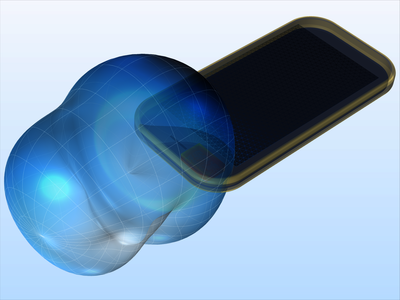
Electrical components in wireless communication systems are designed to be small and lightweight while maintaining decent performance and efficiency. Antennas are essential components in mobile devices and are required to fit in the limited space allowed by industrial specifications. To ... Read More
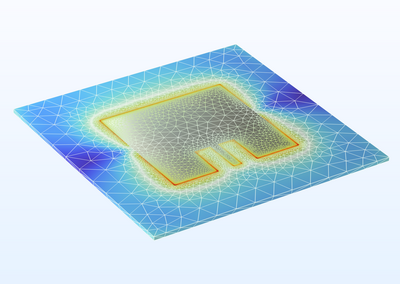
The model utilizes a dedicated mesh refinement study, Frequency Domain RF Adaptive Mesh, which dynamically refines the mesh in the region of interest. For the Application Library model Microstrip Patch Antenna, it increases the mesh resolution around areas with high field variations. The ... Read More

Manual design optimization typically requires numerous sweeps over a parameterized geometry, but it does not guarantee optimal performance under given conditions. Shape optimization removes the need for explicit parameterization and can achieve comparable or even better performance in a ... Read More
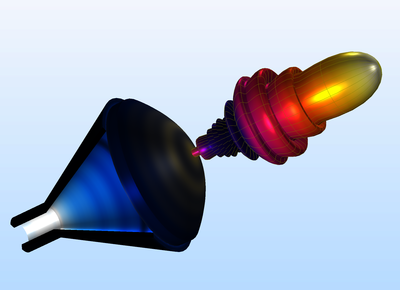
An axisymmetric 3D structure such as a conical horn antenna can be simulated in a fast and efficient way using only its 2D layout. In this model, the antenna radiation and matching characteristics are computed very quickly with respect to the dominant TE mode from the given circular ... Read More
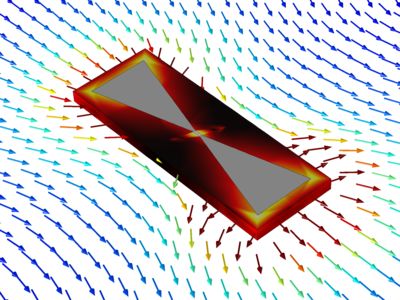
A bow-tie antenna patterned on a dielectric substrate is optimized by adjusting the length of the arms and the flare angle to reduce the magnitude of S11, reflection coefficient. The two geometric dimensions used as design variables directly control the antenna's size and shape, and also ... Read More

This example builds surrogate models with deep neural network (DNN) training to quickly estimate the performance of a microstrip patch antenna based on four design parameters: patch length, tuning stub length, dielectric constant of a substrate, and frequency. The model also simulates a ... Read More
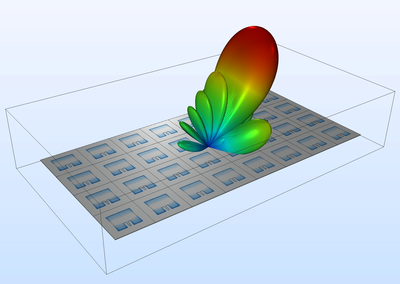
The demand for phased array antennas increases not only for the traditional military industry but also in commercial areas such 5G mobile network platforms, Internet of Things (IoT), and satellite communication applications. This example shows how to design a phased array with a beam ... Read More
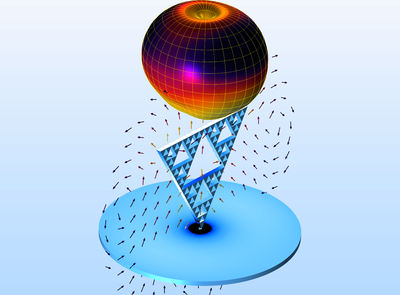
A fractal is a mathematical form showing self-repeating patterns. By virtue of its geometrical properties, a fractal structure can generate multiple resonances in RF applications. This antenna model uses a 3rd order Sierpinski triangle and the calculated S-parameters shows good input ... Read More


