
The Application Gallery features COMSOL Multiphysics® tutorial and demo app files pertinent to the electrical, structural, acoustics, fluid, heat, and chemical disciplines. You can use these examples as a starting point for your own simulation work by downloading the tutorial model or demo app file and its accompanying instructions.
Search for tutorials and apps relevant to your area of expertise via the Quick Search feature. Note that many of the examples featured here can also be accessed via the Application Libraries that are built into the COMSOL Multiphysics® software and available from the File menu.
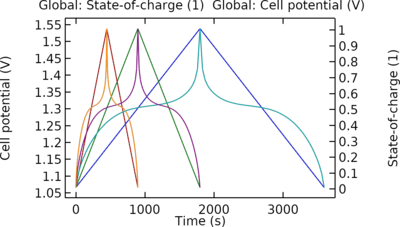
A simple equivalent circuit model approach is presented for Nickel metal hydride batteries. The 0D model consists of resistor, capacitor, current source and state-of-charge based voltage source (SOC). An Arrhenius type dependence is used to account for self-discharge. All model ... Read More
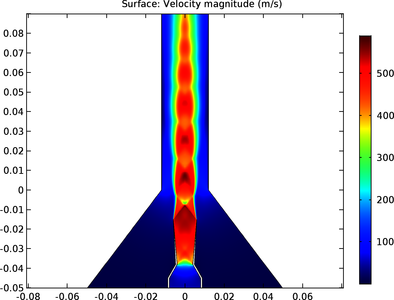
In this study, the compressible turbulent flow through a supersonic ejector is modeled using the High Mach Number Flow interface in the CFD Module. Ejectors are simple mechanical components used for a wide range of applications, including industrial refrigeration, vacuum generation, gas ... Read More
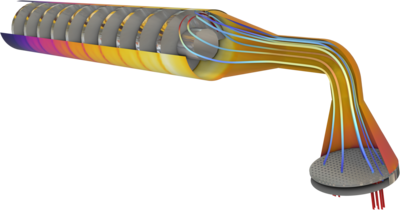
This tutorial example of the pasta extrusion process shows how to simulate the non-isothermal flow of dough in the metering zone of a pasta extruder accounting for the temperature dependent material properties of the hydrated semolina dough. Read More

This model demonstrates dielectric barrier discharge (DBD) in air subjected to an AC applied voltage. As the voltage amplitude increases, the discharge intensity correspondingly strengthens. Furthermore, the dominant component of the discharge current transitions from displacement ... Read More
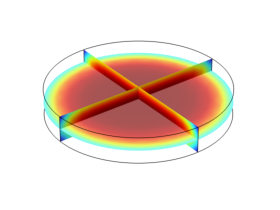
When producing glass, the glass melt is cooled down through radiation to form the final shape, subjecting it to stresses. Numerical treatment of radiative heat transfer, using the Radiative Transfer Equation (RTE), helps to optimize this process. COMSOL Multiphysics provides three ... Read More
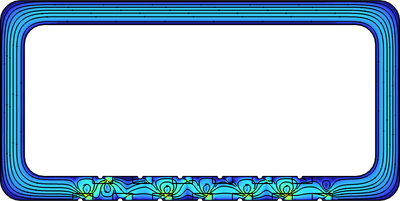
This tutorial uses a 2D model of an acoustically driven microfluidic pump. The acoustic microfluidic pump is driven by acoustic streaming originating from sharp edges in the microfluidic channel. It drives a flow around a closed microfluidic channel loop. The acoustic field is modeled ... Read More

A Chladni plate is a metal plate that is covered in sand and subjected to vibrations. At certain frequencies, the vibrations produce standing waves, resulting in sand patterns formed on the plate. The vibrations are either formed from a violin bow at the side of the plate or a wave ... Read More
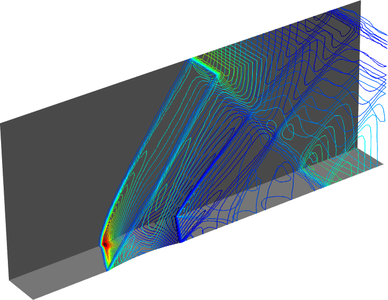
This example models 3D supersonic flow, including the effect of a shock, in a straight channel with a small obstacle on one of the walls. As the flow hits the obstacle, shock waves are diffracted from the obstacle and walls of the channel. The propagating shock waves form a pattern in ... Read More
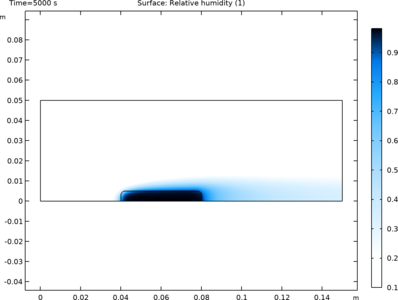
Drying of porous media is an important process in the food and paper industry among others. Many physical effects must be considered: fluid flow, heat transfer with phase change, and transport of participating liquids and gases. All of these effects are strongly coupled, and predefined ... Read More
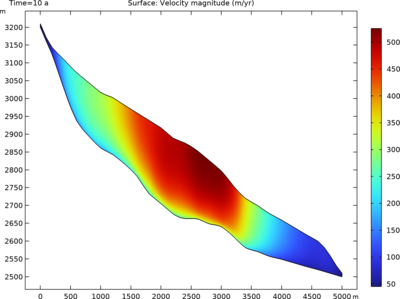
This example shows how to set up a glacier flow model in principle, containing several important aspects of glacier modeling: The creation of the 2D geometry, the modeling of non-Newtonian flow, and the implementation of basal sliding. In this example, two different glacier types, a cold ... Read More