
The Application Gallery features COMSOL Multiphysics® tutorial and demo app files pertinent to the electrical, structural, acoustics, fluid, heat, and chemical disciplines. You can use these examples as a starting point for your own simulation work by downloading the tutorial model or demo app file and its accompanying instructions.
Search for tutorials and apps relevant to your area of expertise via the Quick Search feature. Note that many of the examples featured here can also be accessed via the Application Libraries that are built into the COMSOL Multiphysics® software and available from the File menu.
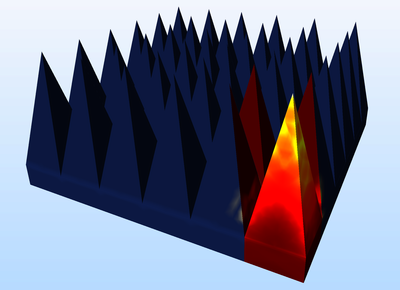
In this model, a microwave absorber is constructed from an infinite 2D array of pyramidal lossy structures. Pyramidal absorbers with radiation-absorbent material (RAM) are commonly used in anechoic chambers for electromagnetic wave measurements. Microwave absorption is modeled using a ... Read More
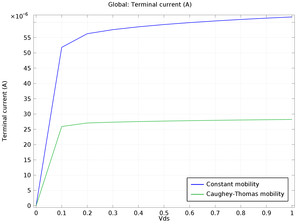
With an increase in the parallel component of the applied field, carriers can gain energies above the ambient thermal energy and be able to transfer energy gained by the field to the lattice by optical phonon emission. The latter effect leads to a saturation of the carriers mobility. The ... Read More
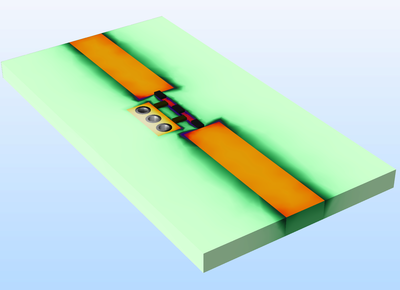
Passive devices can be designed using lumped element features if both the operating frequency of the device and the insertion loss of lumped elements are low. This example simulates two types of lumped element filters that are similar to lumped ports, except that they are strictly ... Read More
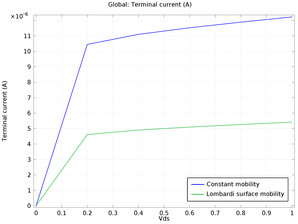
Surface acoustic phonons and surface roughness have an important effect on the carrier mobility, especially in the thin inversion layer under the gate in MOSFETs. The Lombardi surface mobility model adds surface scattering resulting from these effects to an existing mobility model using ... Read More
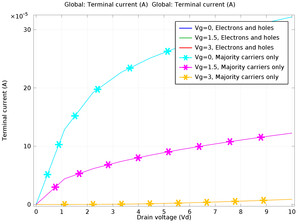
In a MESFET, the gate forms a rectifying junction that controls the opening of the channel by varying the depletion width of the junction. In this model we simulate the response of a n-doped GaAs MESFET to different drain and gate voltages. For a n-doped material the electron ... Read More
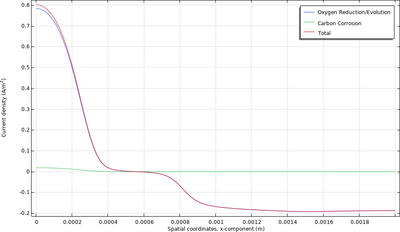
Carbon corrosion is one of the important degradation mechanisms in a Polymer Electrolyte Membrane (PEM) fuel cells which predominantly occurs during start-up or shut down of the fuel cells. During carbon corrosion, carbon support to catalysts is compromised affecting the cell ... Read More

This model studies the dispersion of neutral species band through curved microchannel in an Electroosmotic flow (EOF) . Using Optimization module, geometric optimization is carried out to minimize the curve-induced dispersion.The central idea is to parametrically represent the geometry ... Read More

This is a benchmark model for the 2D axisymmetric formulation of the Electromagnetic Waves, Frequency Domain interface that is available with the RF Module. The problem is to find the resonant frequencies and fields inside an axisymmetric cavity with rectangular cross-section and ... Read More

The first part of the application computes the modes for a straight step index fiber made of silica glass. In the second part, a step index fiber bend with a 3 mm radius of curvature is analyzed with respect to propagating modes and radiation loss. It is shown how to find the power ... Read More
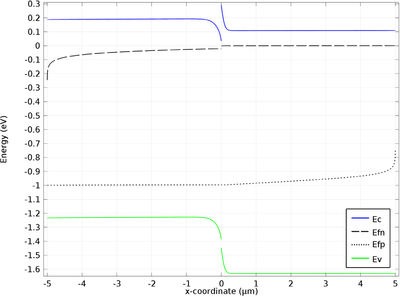
This benchmark model simulates three different heterojunction configurations under forward and reverse bias. It shows the difference in using the continuous quasi-Fermi level formulation versus the thermionic emission formulation for the charge transfer across the heterojunction. The ... Read More


