
The Application Gallery features COMSOL Multiphysics® tutorial and demo app files pertinent to the electrical, structural, acoustics, fluid, heat, and chemical disciplines. You can use these examples as a starting point for your own simulation work by downloading the tutorial model or demo app file and its accompanying instructions.
Search for tutorials and apps relevant to your area of expertise via the Quick Search feature. Note that many of the examples featured here can also be accessed via the Application Libraries that are built into the COMSOL Multiphysics® software and available from the File menu.
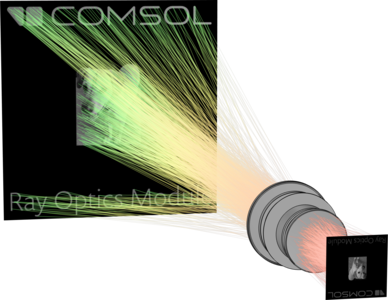
This example demonstrates how to import a bitmap which can be used to simulate an image using ray tracing. The example is based on the Double Gauss Lens tutorial from the Ray Optics Module Application Library. The first study has been modified so that the Spot Diagram "auto-focus" tool ... Read More
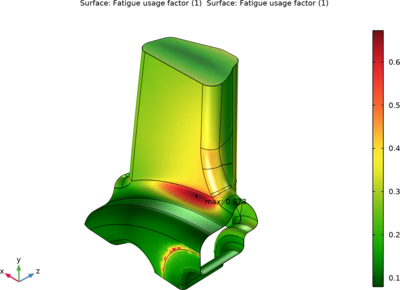
High Cycle Fatigue (HCF) of a spoke in a wheel rim is studied. As the wheel rotates, the stress histories in the structure will become nonproportional. The risk of fatigue is evaluated using the Findley criterion. Read More

Coplanar waveguide (CPW) bandpass filters can be designed using interdigital capacitors (IDCs) and short-circuited stub inductors (SSIs). This is a very efficient manufacturing method for producing bandpass filters, which can readily be implemented on a GaAs wafer. The Coplanar ... Read More
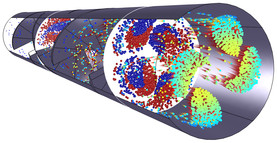
In static mixers, also called motionless or in-line mixers, a fluid is pumped through a pipe containing stationary blades. This mixing technique is particularly well suited for laminar flow mixing because it generates only small pressure losses in this flow regime. This example studies ... Read More
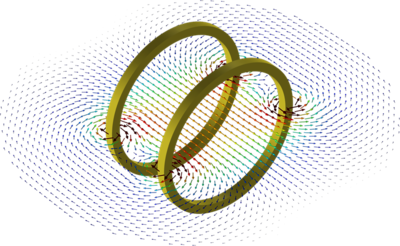
A Helmholtz coil is a parallel pair of identical circular coils spaced one radius apart and wound so that the current flows through both coils in the same direction. This winding results in a uniform magnetic field between the coils with the primary component parallel to the axes of the ... Read More
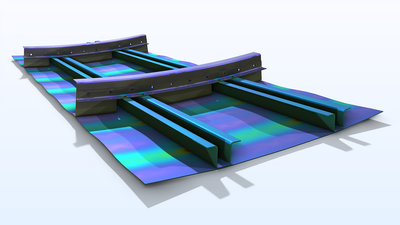
This model studies the structural deformation of an aircraft fuselage structure subjected to buckling loads. The structure is an assembly of panels and skin connected by rivets. The Fasteners feature sets up a large number of connections and computes the forces acting on each rivet. Read More
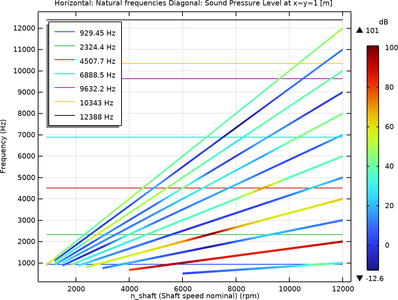
The noise emitted from an electrical machine can have many sources. In this example, acoustic noise from vibrations created by magnetic force variation is studied. Such noise is often audible at twice the excitation frequency but can also occur at higher frequencies or harmonics of the ... Read More
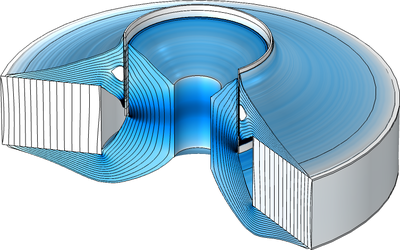
This model presents two examples of topology optimization of the magnetic circuit of a loudspeaker driver. A first optimization is used to find the design of a nonlinear iron pole piece and top plate that maximize the BL factor at the resting position (small displacements), while ... Read More


