
The Application Gallery features COMSOL Multiphysics® tutorial and demo app files pertinent to the electrical, structural, acoustics, fluid, heat, and chemical disciplines. You can use these examples as a starting point for your own simulation work by downloading the tutorial model or demo app file and its accompanying instructions.
Search for tutorials and apps relevant to your area of expertise via the Quick Search feature. Note that many of the examples featured here can also be accessed via the Application Libraries that are built into the COMSOL Multiphysics® software and available from the File menu.
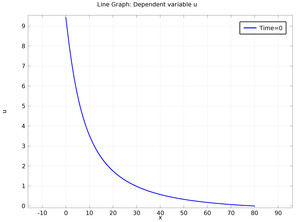
The Black-Scholes equation, computes the value u of a European stock option. Black-Scholes derived an analytical expression for the solution to this problem. However, the formula works only for certain cases; for instance, you cannot employ it when sigma and r are functions of x and t. ... Read More
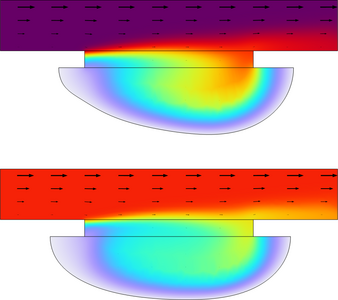
This model illustrates how to improve the symmetry of a wet chemical etching process by varying the convection and chemical concentration as a function time. Read More
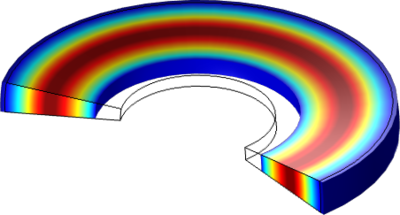
This example illustrates how to combine different Creep material models. Here a Norton–Bailey model (primary creep) is combined with a Norton model (secondary creep). This example is a continuation of the model thermally induced creep. Read More
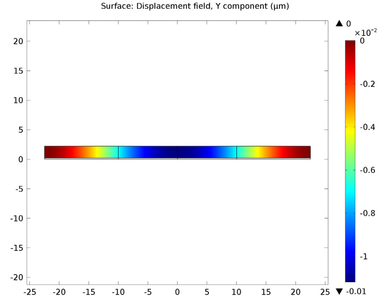
Silicon micromechanical resonators have long been used for designing sensors and are now becoming increasingly important as oscillators in the consumer electronics market. In this series of models, a surface micromachined MEMS resonator, designed as part of a micromechanical filter, is ... Read More
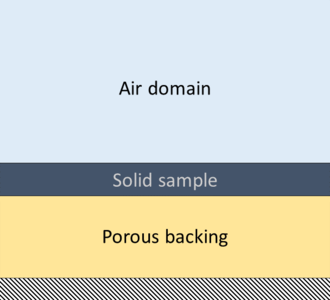
This app allows to calculate the absorption coefficient and surface impedance of a sound absorbers for normal and random incidences. The computed quantities can be used when setting up boundary conditions in a Pressure Acoustics, Frequency Domain model or a Ray Acoustics model. The ... Read More
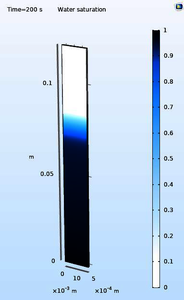
This example models wicking in a porous medium. Wicking is the phenomenon that occurs when a dry porous material is put into contact with a fluid: it will absorb the fluid due to capillary forces. The absorption will continue until an equilibrium is reached where the gravitational forces ... Read More
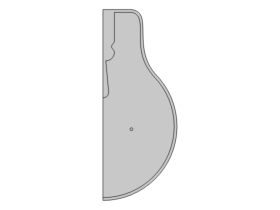
This tutorial introduces a workflow typical of creating geometry for simulation by using Sketch mode to draw complex shapes. Follow the step-by-step instructions to draw the geometry for the analysis of a light bulb. The physics setup is described in the model Free Convection in a Light ... Read More

This model demonstrates how to optimize the charging profile of a battery using gradient based optimization. The optimization solver minimizes the time required for charging the battery from 0% to 90% state of charge, while at the same time constraining the amount lithium inventory lost ... Read More
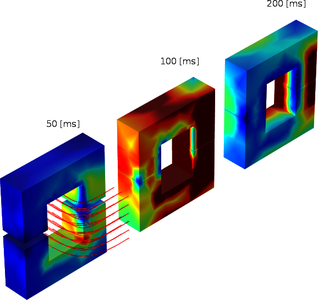
Electrical events, such as an overcurrent or overload, can seriously damage electrical circuits or power lines. To avoid expensive replacements of critical parts, electric switch circuit breakers can be installed. These mechanically interrupt the current flow or surge by moving a plunger ... Read More
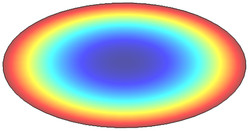
This benchmark model computes the total force acting on a vibrating disc in the frequency and time domains and compares both results with expressions derived analytically. When the vibration amplitude is small enough that the system is linear the frequency and time domain results agree ... Read More


