
The Application Gallery features COMSOL Multiphysics® tutorial and demo app files pertinent to the electrical, structural, acoustics, fluid, heat, and chemical disciplines. You can use these examples as a starting point for your own simulation work by downloading the tutorial model or demo app file and its accompanying instructions.
Search for tutorials and apps relevant to your area of expertise via the Quick Search feature. Note that many of the examples featured here can also be accessed via the Application Libraries that are built into the COMSOL Multiphysics® software and available from the File menu.
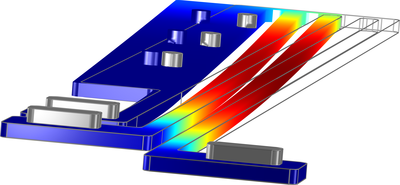
This example model consists of a two-hot-arm thermal actuator made of polysilicon. The actuator is activated through thermal expansion. The temperature increase required to deform the two hot arms, and thus displace the actuator, is obtained through Joule heating (resistive heating). The ... Read More
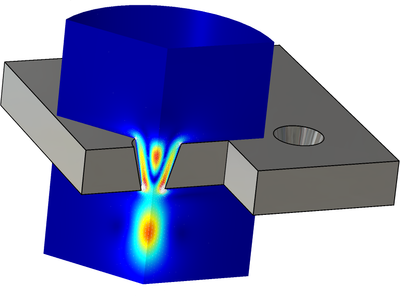
This model analyzes the nonlinear transfer impedance of a tapered orifice that can be part of a perforate or microperforated plate (MPP). The analysis is carried out for various degrees of tapering of the perforate and for a frequency range. A linear analysis is set up in the frequency ... Read More
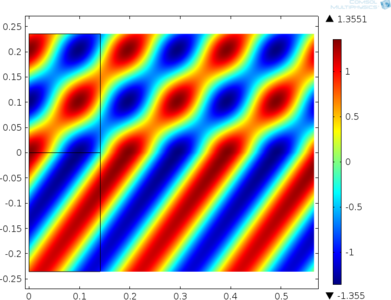
This model determines the reflection coefficient of plane acoustic waves, at different frequencies and at different angles of incidence, off a water-sediment interface. The ability of the Poroelasitc Waves interface to model the coupled acoustic and elastic wave in any porous substance ... Read More
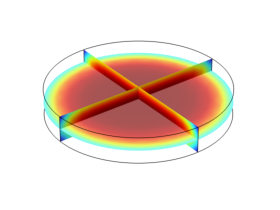
When producing glass, the glass melt is cooled down through radiation to form the final shape, subjecting it to stresses. Numerical treatment of radiative heat transfer, using the Radiative Transfer Equation (RTE), helps to optimize this process. COMSOL Multiphysics provides three ... Read More
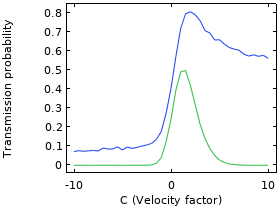
The Monte Carlo simulation of flow in a turbomolecular pump can be greatly simplified if the mean radius of the blades is much greater than the spacing between them. Under these conditions, the rotating blades of the pump can be approximated as an infinite row of blades having only ... Read More
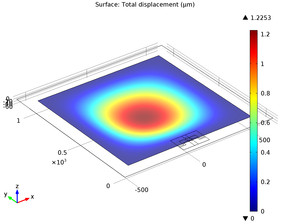
Piezoresistive pressure sensors were some of the first MEMS devices to be commercialized. Compared to capacitive pressure sensors, they are simpler to integrate with electronics, their response is more linear and they are inherently shielded from RF noise. They do, however, usually ... Read More
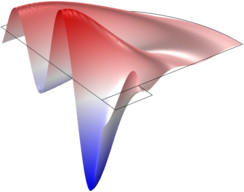
A piezoelectric speaker, colloquially known as a piezo buzzer, is a type of piezoelectric transducer that uses a piezoelectric crystal attached to a membrane. The movement of the crystal induces bending of the membrane and thus generates acoustic pressure waves. This model simulates an ... Read More
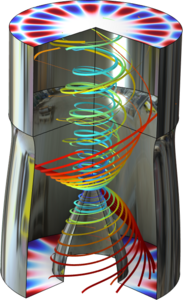
The acoustic field in a model of an axially symmetric lined aero-engine duct, based on modal sound transmission, is analyzed. The source is generated by a single mode excitation at a boundary. Sources and nonreflecting conditions are applied using port boundary conditions. The model ... Read More


