
The Application Gallery features COMSOL Multiphysics® tutorial and demo app files pertinent to the electrical, structural, acoustics, fluid, heat, and chemical disciplines. You can use these examples as a starting point for your own simulation work by downloading the tutorial model or demo app file and its accompanying instructions.
Search for tutorials and apps relevant to your area of expertise via the Quick Search feature. Note that many of the examples featured here can also be accessed via the Application Libraries that are built into the COMSOL Multiphysics® software and available from the File menu.
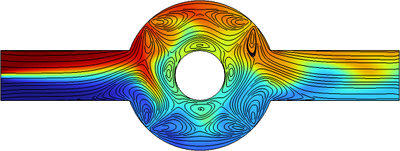
Microlaboratories for biochemical applications often require rapid mixing of different fluid streams. At the microscale, flow is usually highly ordered laminar flow, and the lack of turbulence makes diffusion the primary mechanism for mixing. While diffusional mixing of small ... Read More

Nanoparticles have become widely used in a range of applications. For example, in pharmaceuticals, particles on the nanoscale, such as nanocrystals, are often used as an effective means of drug delivery. Meanwhile in material sciences, nanoparticle coating is an increasingly common way ... Read More
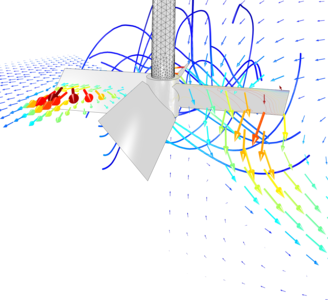
This model shows how to use simulations to predict power numbers with Power Law fluids in a mixer. It simulates the behavior of flow in a flat bottom tank with a single four-blade pitched impeller. The flow was modeled as laminar and the frozen rotor approach was used to solve the ... Read More
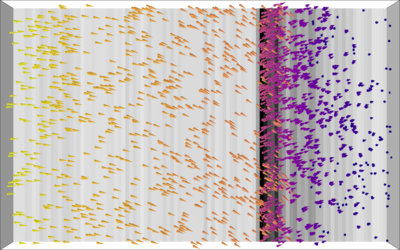
Multipaction can occur when electrons are accelerated by a high frequency RF field into surfaces. At certain frequencies, the number of electrons in a cavity can grow exponentially. This exponential growth cannot continue indefinitely because space charge effects in the cavity can ... Read More
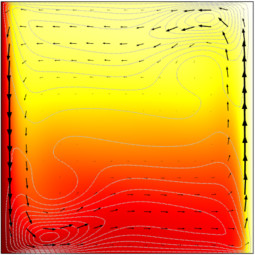
This model couples the Navier Stokes equations and the heat transfer equations to examine density driven flow of free fluids. Here the fluid is in a square cavity with a heated wall. The buoyancy force is a Boussinesq term added to the Navier-Stokes equations. The equation is ... Read More
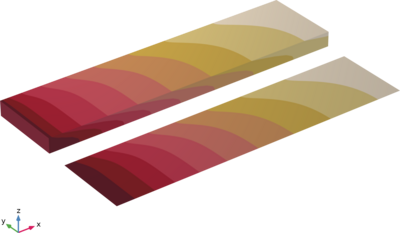
This application shows how mass transfer out from a thin 3D domain can be approximated using a 2D component with the domain feature Out-of-Plane Flux. This feature is useful when the concentration gradient in the out-of-plane direction (along the thickness) is small, and decreasing the ... Read More
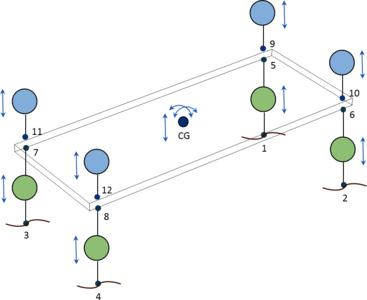
In this example, a lumped model of a vehicle suspension system having 11 degrees of freedom is analyzed. The Mass, Spring, and Damper nodes of the Lumped Mechanical System interface are used to model the wheels, including suspension system as well as the seats with a passenger. The ... Read More
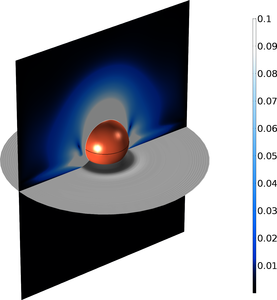
This model shows modeling of a sphere falling on a water surface. Specifically, it models the oscillating motion of a buoyant sphere as it falls through air and interacts with the air-water interface to finally float on water. Get more details in our blog post: Modeling a Sphere Falling ... Read More
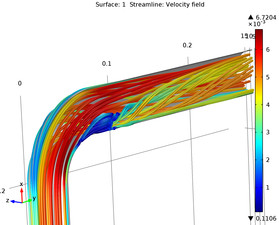
This example models the flow in a 90-degree pipe elbow. The flow is simulated using the k-omega turbulence model. The result is compared to engineering correlations. Read More
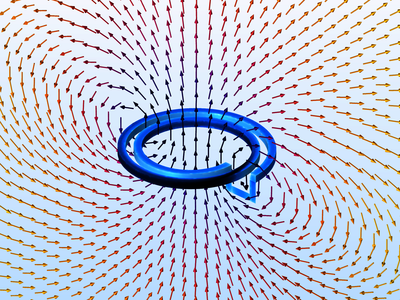
RF coils are important in numerous applications ranging from wireless technology to MRI scanning equipment. This introductory tutorial model demonstrates how to find the fundamental resonance frequency of an RF coil as well as how to perform a frequency sweep to extract the coil's Q ... Read More


