
The Application Gallery features COMSOL Multiphysics® tutorial and demo app files pertinent to the electrical, structural, acoustics, fluid, heat, and chemical disciplines. You can use these examples as a starting point for your own simulation work by downloading the tutorial model or demo app file and its accompanying instructions.
Search for tutorials and apps relevant to your area of expertise via the Quick Search feature. Note that many of the examples featured here can also be accessed via the Application Libraries that are built into the COMSOL Multiphysics® software and available from the File menu.
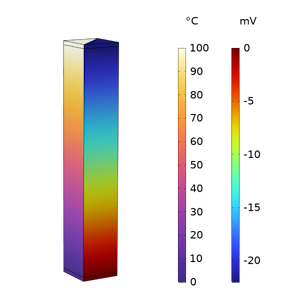
In this model, we show how to model Seebeck effect which works as a thermoelectric generator. Seebeck effect is a phenomena where the difference in temperature of a material leads to a potential difference. The potential drawn in this model was compared with the paper by Jaegle (Example ... Read More
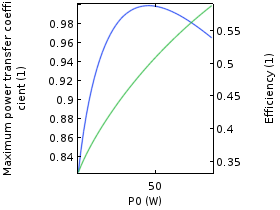
This tutorial drives a capacitively coupled plasma with an L-type matching network at high and low powers. At low power, where the harmonics in the current are low, prefect matching is obtained at the chosen power value. Sweeps over power, frequency, and pressure are performed and their ... Read More
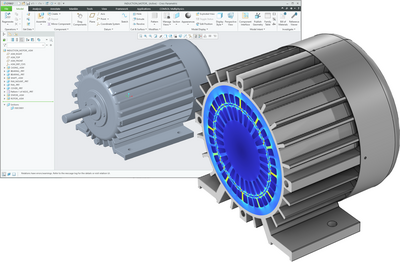
This model illustrates how to compute the torque of a three-phase squirrel-cage induction motor at various speeds. In the example the torque is computed by averaging the results from simulations performed on 2D cross sections at several locations along the induction motor. The 3D ... Read More
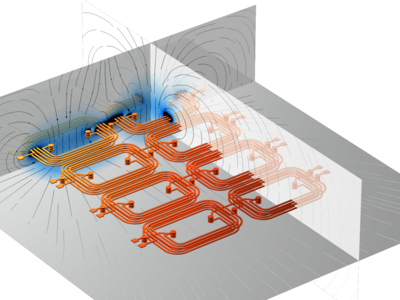
This model demonstrates how to use the Magnetic Fields, Currents Only interface together with the Stationary Source Sweep with Initialization study to compute the inductance matrix of PCB coils with a number of 12. Read More
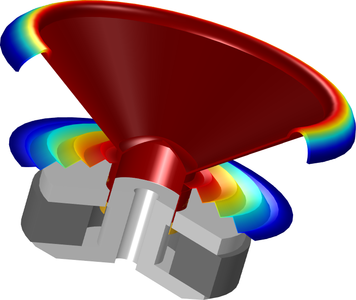
This example shows how to model a loudspeaker driver of the dynamic cone type, common for low and medium frequencies. The analysis is carried out in the frequency domain and thus represents the linear behavior of the driver. The model analysis includes the total electric impedance and ... Read More
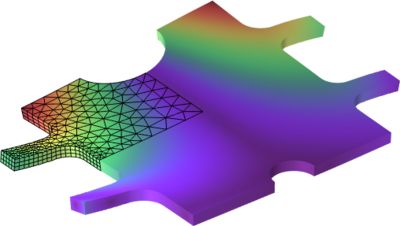
In this tutorial, the vibrational behavior of a small aluminum plate with four waveguide structures is analyzed. This is an example of a structural component located in a device where elastic waves are propagating, like a smart speaker, an electric motor, or a MEMS device. The plate can ... Read More
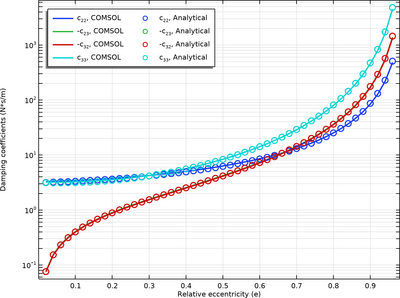
Squeeze film dampers are components that provide additional damping to rotating machines. To simplify the modeling of a rotor assembly, squeeze film dampers are modeled in terms of their damping coefficients which are a functions of the journal location in the damper. This model computes ... Read More
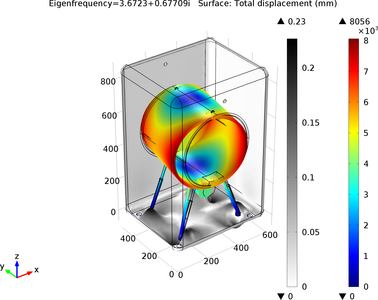
Vibration and noise in washing machines, due to the non-uniform distribution of clothes in the barrel, is a common problem worth studying and optimizing for. This model simulates a multibody dynamics model of a horizontal-axis portable washing machine. An eigenfrequency analysis is ... Read More
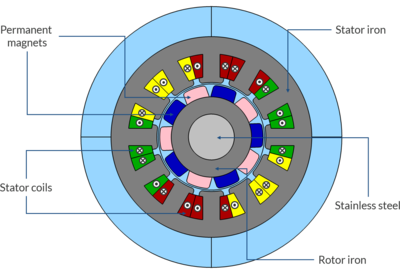
This is a primer model of a permanent magnet machine. It is a generic model that can be modified to simulate a motor or generator. It demonstrates different capabilities of COMSOL Multiphysics® to examine aspects of machine design, such as air gap magnetomotive force (MMF), ... Read More
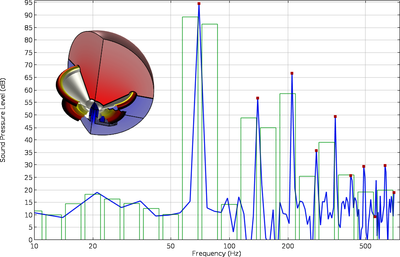
In this model, a full transient analysis of a loudspeaker driver is performed, which allow the modeling of nonlinear effects. It extends the linear frequency domain analysis done in the Loudspeaker Driver tutorial model. The analysis accounts for nonlinear behavior of the soft iron in ... Read More


