
The Application Gallery features COMSOL Multiphysics® tutorial and demo app files pertinent to the electrical, structural, acoustics, fluid, heat, and chemical disciplines. You can use these examples as a starting point for your own simulation work by downloading the tutorial model or demo app file and its accompanying instructions.
Search for tutorials and apps relevant to your area of expertise via the Quick Search feature. Note that many of the examples featured here can also be accessed via the Application Libraries that are built into the COMSOL Multiphysics® software and available from the File menu.
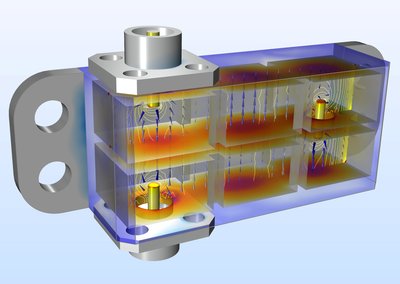
This example investigates the electrical performance of a cascaded cavity filter operating in the millimeter-wave 5G band with temperature changes. The thermal variations result in structural deformations of the structure. Thus, the resonant frequencies of the filter elements (cavities) ... Read More
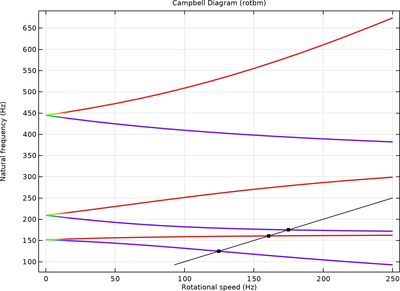
Different types of elements can be used for modeling a rotor, depending on the level of complexity and the type of the system being modeled. The modeling steps and representation of the results will vary with the type of idealization. In this tutorial model, an eigenfrequency analysis is ... Read More
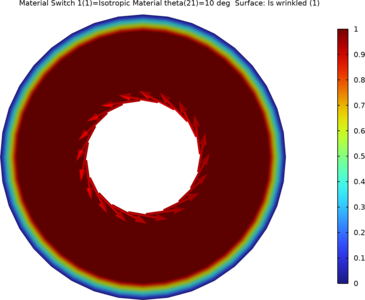
In this example, a torque is applied to the inner edge of a circular annulus-shaped membrane while the outer edge is fixed, resulting in membrane wrinkling. The wrinkling membrane model avoids the equilibrium instability that would be produced by the compressive stresses. The effect of ... Read More
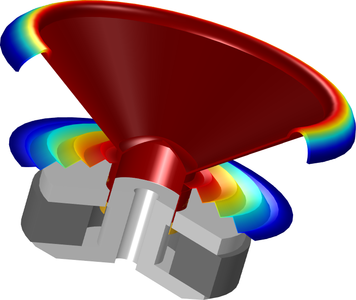
This example shows how to model a loudspeaker driver of the dynamic cone type, common for low and medium frequencies. The analysis is carried out in the frequency domain and thus represents the linear behavior of the driver. The model analysis includes the total electric impedance and ... Read More
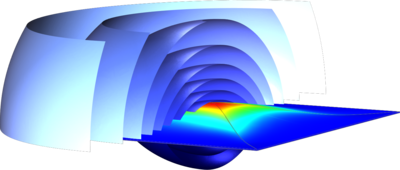
This model analyzes a piezoelectric microelectromechanical system (MEMS) speaker. The speaker, composed of four triangular membranes, uses a layer of lead zirconate titanate (PZT) material with two electrodes on top of a silicon layer as actuators. The triangular membranes are separated ... Read More
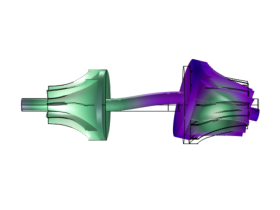
Cross-coupled forces present in a hydrodynamic bearing often act as a negative damping in a rotor. Near the critical speed, this may lead to uncontrolled vibration of the turbocharger causing a risk of bearing failure. In this example, the influence of the cross-coupling forces on the ... Read More
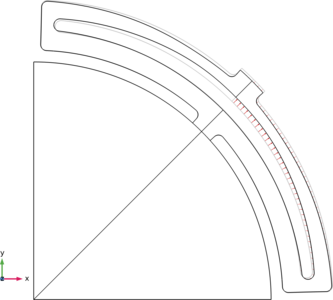
This model demonstrates how to tune the lowest natural frequency of the diaphragm of a MEMS microphone using Shape Optimization. The Stationary then Eigenfrequency study modifies the shape of the suspension springs that support the diaphragm. Although the model is in 3D, shape change is ... Read More
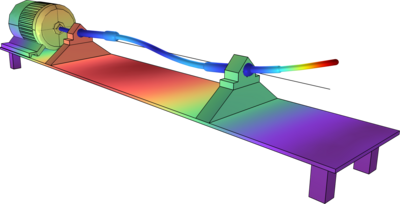
Active magnetic bearings are often used for controlling the vibration level in mechanical systems. In this example, a motor driven rotor system in which the speed of the system is gradually increased is considered. The system vibrates due to existing imbalances. As the rotor speed ... Read More