
The Application Gallery features COMSOL Multiphysics® tutorial and demo app files pertinent to the electrical, structural, acoustics, fluid, heat, and chemical disciplines. You can use these examples as a starting point for your own simulation work by downloading the tutorial model or demo app file and its accompanying instructions.
Search for tutorials and apps relevant to your area of expertise via the Quick Search feature. Note that many of the examples featured here can also be accessed via the Application Libraries that are built into the COMSOL Multiphysics® software and available from the File menu.
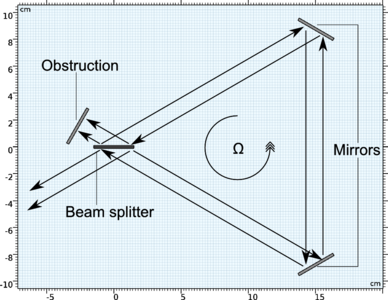
This is a model of a simple Sagnac interferometer consisting of two mirrors and a beam splitter arranged in a triangle. The entire modeling domain rotates; as a result, the rays propagating in opposite directions in the triangle have different optical path lengths due to the Sagnac ... Read More
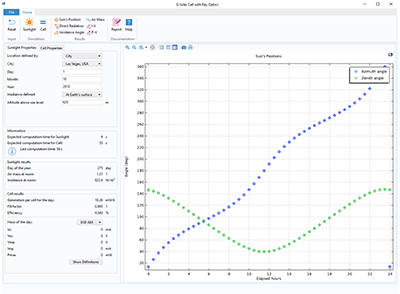
This app demonstrates the following: Multiple components (1D and 3D) in a single app Using the same choice list in the app as in the model using Data Access functionality Output numerical results for a specific time step using a combo box The app combines the Ray Optics Module and ... Read More
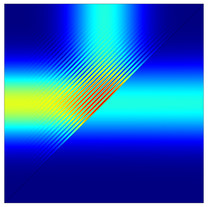
A beam splitter is used to split a single beam of light into two. One way of making a splitter is to deposit a thin layer of metal between two glass prisms. The beam is slightly attenuated within the layer, and split into two paths. In this example, the thin metal layer is modeled using ... Read More
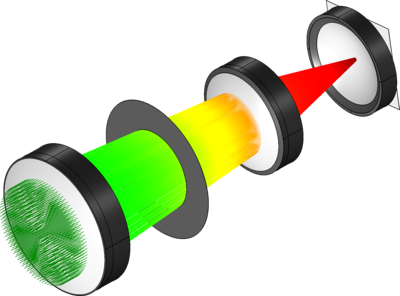
This tutorial shows how to set up a multi-element objective lens. The chosen lens is a Petzval lens with field flattener described in 'Fundamental Optical Design', by M. Kidger, 2001, pg 192. The tutorial demonstrates how to include a geometric sequence using the 'Spherical General Lens ... Read More
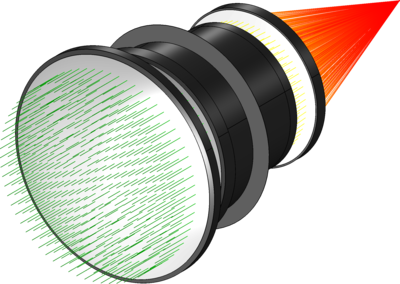
This tutorial shows how to set up a multi-element objective lens. The chosen lens is the Double Gauss described in 'Modern Lens Design (2nd edition)', by W. Smith, 2005, pg 323. The tutorial demonstrates how to create a geometry sequence using the 'Spherical Lens 3D' part found in the ... Read More
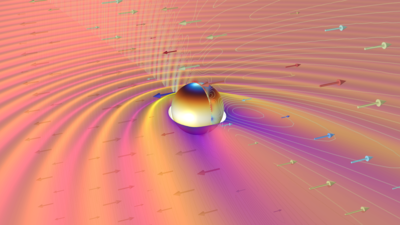
This verification model uses the Electromagnetic Waves, Boundary Elements interface to simulate the RCS of perfectly conducting sphere. The simulated result is compared to analytical calculation to verify the accuracy. Read More
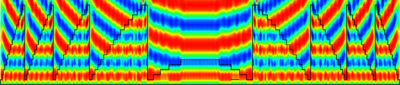
This model simulates a 16-level, first-order, focusing Fresnel lens with 50 µm diameter and 150 µm focal length. In one simulation, the Electromagnetic Waves, Frequency Domain interface computes the electric field in the Fresnel lens and the surrounding air domain extended to the focal ... Read More
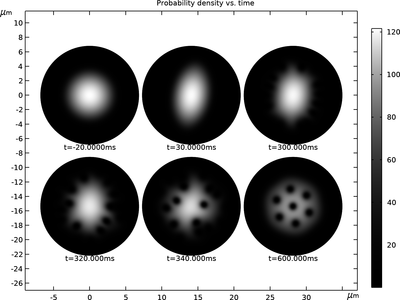
This tutorial model solves the Gross–Pitaevskii Equation for the vortex lattice formation in a rotating Bose–Einstein condensate bound by a harmonic trap. The equation is essentially a nonlinear single-particle Schrödinger Equation, with the inter-particle interaction represented by a ... Read More

Optical lenses of millimeter size cannot easily be analyzed with the Electromagnetic Waves, Frequency Domain interface on standard workstations due to the large number of finite element mesh elements required. This model explains how the Electromagnetic Waves, Beam Envelopes interface ... Read More
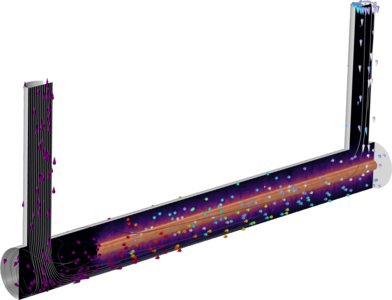
In this example, a simple ultraviolet (UV) water purification reactor is modeled using a combination of ray tracing, computational fluid dynamics, and Lagrangian particle tracking. First, the volumetric fluence rate is accumulated along rays released from the surface of the UV lamp using ... Read More