
The Application Gallery features COMSOL Multiphysics® tutorial and demo app files pertinent to the electrical, structural, acoustics, fluid, heat, and chemical disciplines. You can use these examples as a starting point for your own simulation work by downloading the tutorial model or demo app file and its accompanying instructions.
Search for tutorials and apps relevant to your area of expertise via the Quick Search feature. Note that many of the examples featured here can also be accessed via the Application Libraries that are built into the COMSOL Multiphysics® software and available from the File menu.
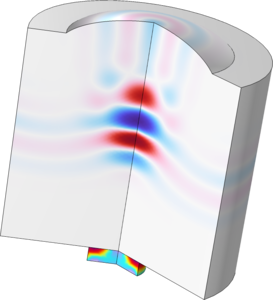
Piezoelectric devices are widely used as sources to generate sound waves or receivers to detect acoustic signals. In applications such as ultrasound imaging and nondestructive testing, the same transducer can be used as a transmitter to send a source signal and receiver to detect ... Read More
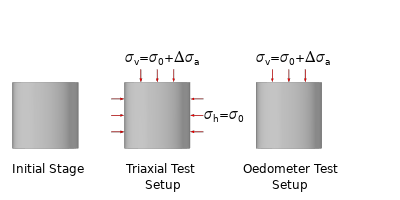
In this example, triaxial and oedometer tests are simulated using the Modified Cam-Clay material model. A nonlinear stress-strain relation is recovered with the constant Poisson's ratio formulation. The hardening and softening behavior is recovered for normally consolidated and highly ... Read More
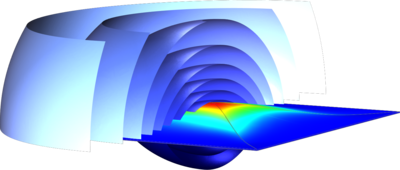
This model analyzes a piezoelectric microelectromechanical system (MEMS) speaker. The speaker, composed of four triangular membranes, uses a layer of lead zirconate titanate (PZT) material with two electrodes on top of a silicon layer as actuators. The triangular membranes are separated ... Read More
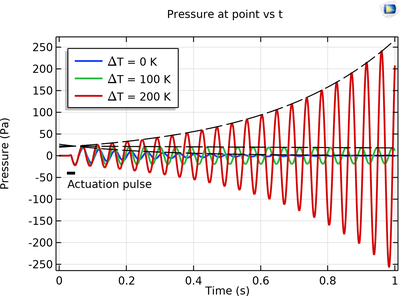
This is a model of a simple thermoacoustic engine that includes a thermal stack to convert thermal energy to acoustic energy. The model is set up using two approaches: 1) Using a linear perturbation (acoustic) approaches solving the fluid motion with the Thermoviscous Acoustics, ... Read More
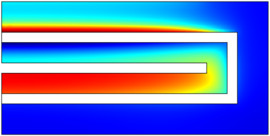
The following example is a 2D tutorial model of a lithium-ion battery. The cell geometry is not based on a real application; it is only meant to demonstrate a 2D model setup. Read More

Micromirrors are used in certain MEMS devices to control optic elements. This example model illustrates a mirror that is initially actuated for a short time and then exhibits damped vibrations. It simulates a vibrating micromirror surrounded by air and uses the Thermoviscous Acoustics, ... Read More
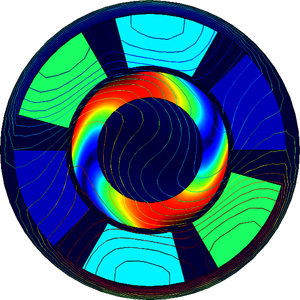
This three-phase induction motor model is used to compare with Testing Electromagnetic Analysis Method (TEAM) workshop problem 30. The Magnetic Fields physics interface is used to model the motor in the frequency domain at 60 Hz. The Velocity (Lorentz Term) feature is used to model the ... Read More
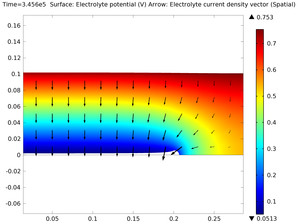
This example shows how to model secondary current distribution and electrode growth with a moving geometry. To avoid numerical instabilities, a seed layer is introduced in the initial geometry to obtain a right angle at the edge between the growing electrode and the insulator. Read More
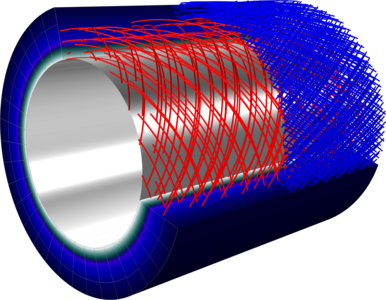
This model shows how to implement an anisotropic, incompressible, hyperelastic material for modeling soft collagenous tissue in arterial walls. The hyperelastic material model implemented is based on the articles: Holzapfel, G. A., Gasser, T. C., & Ogden, R. W. (2000), A new ... Read More

These models demonstrate the implementation of a Helmholtz filter to: Smooth noisy input data to a transient simulation Smooth spatially varying data over an arbitrary surface Generate a mesh that is adapted to the spatial variation of an input load Learn more in the accompanying ... Read More


