
The Application Gallery features COMSOL Multiphysics® tutorial and demo app files pertinent to the electrical, structural, acoustics, fluid, heat, and chemical disciplines. You can use these examples as a starting point for your own simulation work by downloading the tutorial model or demo app file and its accompanying instructions.
Search for tutorials and apps relevant to your area of expertise via the Quick Search feature. Note that many of the examples featured here can also be accessed via the Application Libraries that are built into the COMSOL Multiphysics® software and available from the File menu.
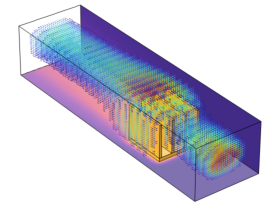
This tutorial model uses a heat sink geometry from the Part Library. The tutorial shows different approaches to heat transfer modeling when studying the cooling of an electronic chip. In the first part, only the solid parts are modeled, while the convective airflow is modeled using ... Read More
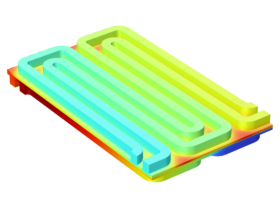
This tutorial explores the current distribution in a low-temperature PEMFC when using serpentine-based flow field patterns. The cell is operated in counter-flow mode so that the oxygen and hydrogen inlet flow streams are located at opposite sides. Relatively dry inlet gas compositions ... Read More
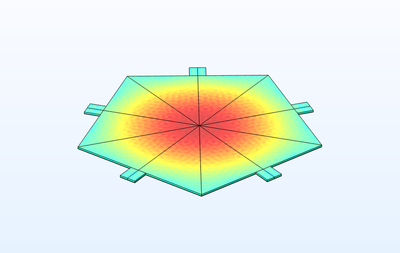
This tutorial demonstrates how an electrical circuit model of a MEMS resonator can be derived using the Parameter Estimation feature. The model is a modified Butterworth-Van Dyke circuit created using the Electrical Circuit interface and represents a Thin-Film Bulk Acoustic Resonator ... Read More
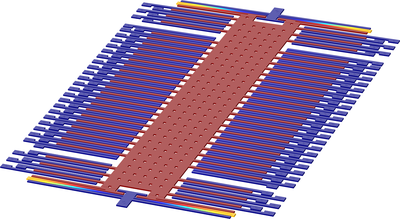
This model shows how to simulate a capacitively actuated surface micromachined accelerometer, using the Electromechanics Interface. It is based on a case study from the book Microsystem Design by Stephen D. Senturia (Kluwer Academic Publishers, 5th Edition, 2003, pages 513-525). Read More
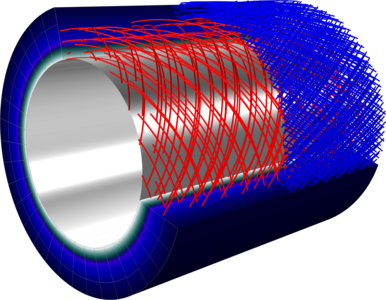
This model shows how to implement an anisotropic, incompressible, hyperelastic material for modeling soft collagenous tissue in arterial walls. The hyperelastic material model implemented is based on the articles: Holzapfel, G. A., Gasser, T. C., & Ogden, R. W. (2000), A new ... Read More
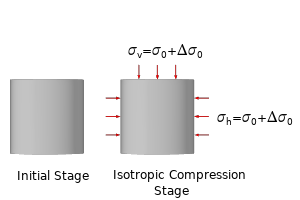
This model simulates the isotropic compression of naturally structured and artificially structured clays using the Modified Structured Cam-Clay (MSCC) material model. The aim of the example is to reproduce the compression behavior given in a benchmark for four structured clays. Read More
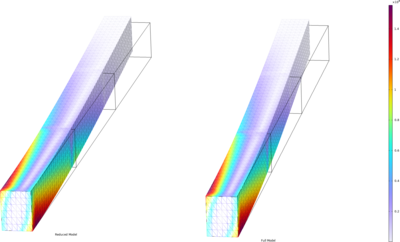
In this tutorial example, the concepts of Component Mode Synthesis (CMS) are introduced through a simple solid model of a cantilever beam. Parts of the beam are reduced by the CMS technique. It is, furthermore, shown how CMS can be used to represent both the static and dynamic behavior ... Read More
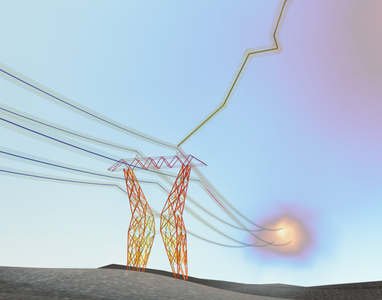
This model demonstrates the analysis of lightning surges on high voltage transmission line towers. Lightning carrying a current of 10 kA struck one of the tower's shielded wires. The induced voltage at the three-phase conductors are computed. Some highlights of this model: Perform ... Read More
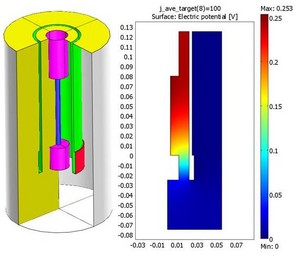
Rotating cylinder Hull cells are an important experimental tool in electroplating and electrodeposition and are used for the measurement of nonuniform current distribution, mass transport, and throwing power of plating baths. The model reproduces the results for a commercially available ... Read More
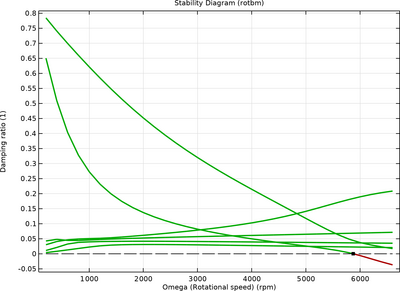
In this tutorial model, you will see how to set up an eigenfrequency analysis of a rotor with multiple disks and bearings. The example illustrates how to use Campbell and stability diagrams to identify the critical speeds and the stability threshold. The rotor is modeled using the Beam ... Read More


