
The Application Gallery features COMSOL Multiphysics® tutorial and demo app files pertinent to the electrical, structural, acoustics, fluid, heat, and chemical disciplines. You can use these examples as a starting point for your own simulation work by downloading the tutorial model or demo app file and its accompanying instructions.
Search for tutorials and apps relevant to your area of expertise via the Quick Search feature. Note that many of the examples featured here can also be accessed via the Application Libraries that are built into the COMSOL Multiphysics® software and available from the File menu.
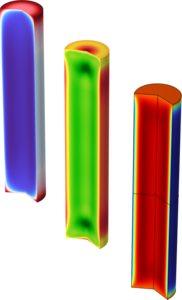
A steel billet is quenched in oil from its austenitic state. A 2D axisymmetric model is used to simulate the coupled problem of austenite decomposition, heat transfer, and solid mechanics. During the quenching process, the austenite decomposes into a combination of ferrite, pearlite, ... Read More
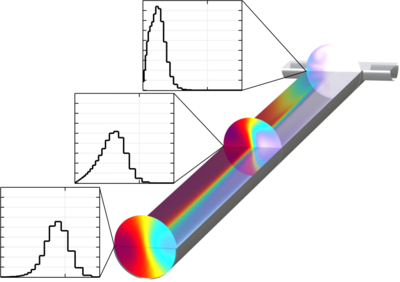
Crystallization is an important separation process in the chemical industry. It is used for the production of pharmaceuticals and industrial chemicals. It can also be used in resource recovery as a way of separating valuable materials from waste. This model solves a discretized ... Read More
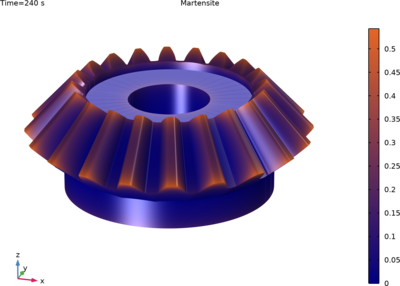
A 3D model is used to simulate the cooling of a bevel gear from an austenitic state. Phase material properties and phase transformation data are imported into the model. The final phase composition and the residual stress state are computed. Phenomena such as thermal strains, phase ... Read More
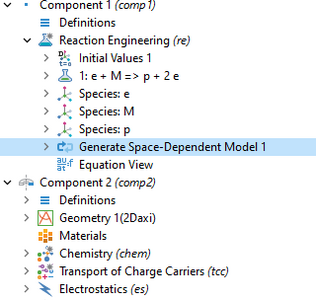
The example shows how to generate a discharge model from the Reaction Engineering interface with a self-defined discharge chemistry. It reproduces the library model 127181 (Double-Headed Streamer in Parallel-Plate Electrodes). Read More
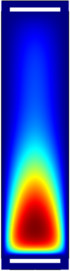
DC glow discharges in the low-pressure regime have long been used for gas lasers and fluorescent lamps. DC discharges are attractive to study because the solution is time independent. The 1D and 2D models show how to use the DC Discharge interface to set up an analysis of a positive ... Read More
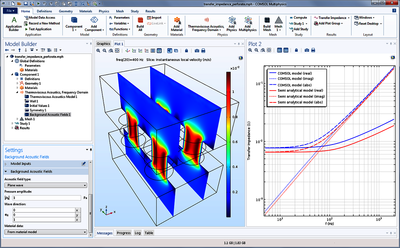
Perforates are plates with a distribution of small perforations or holes. They are used in muffler systems, sound absorbing panels, and in many other places as liners, where it is important to control attenuation precisely. As the perforations become smaller and smaller, viscous and ... Read More
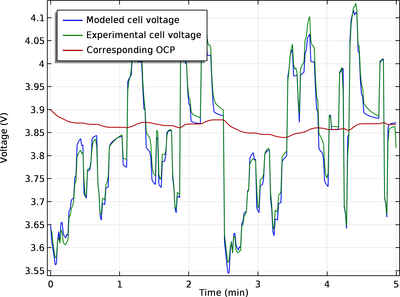
This tutorial uses a “black-box” approach to define a battery model based on a small set of lumped parameters, assuming no knowledge of the internal structure or design of the battery electrodes, or choice of materials. The input to the model is the battery capacity, the initial state ... Read More
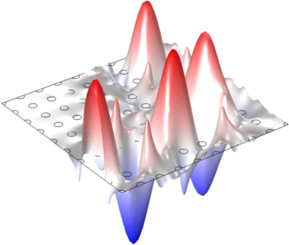
Photonic crystal devices are periodic structures of alternating layers of materials with different refractive indices. Waveguides that are confined inside of a photonic crystal can have very sharp low-loss bends, which may enable an increase in integration density of several orders of ... Read More
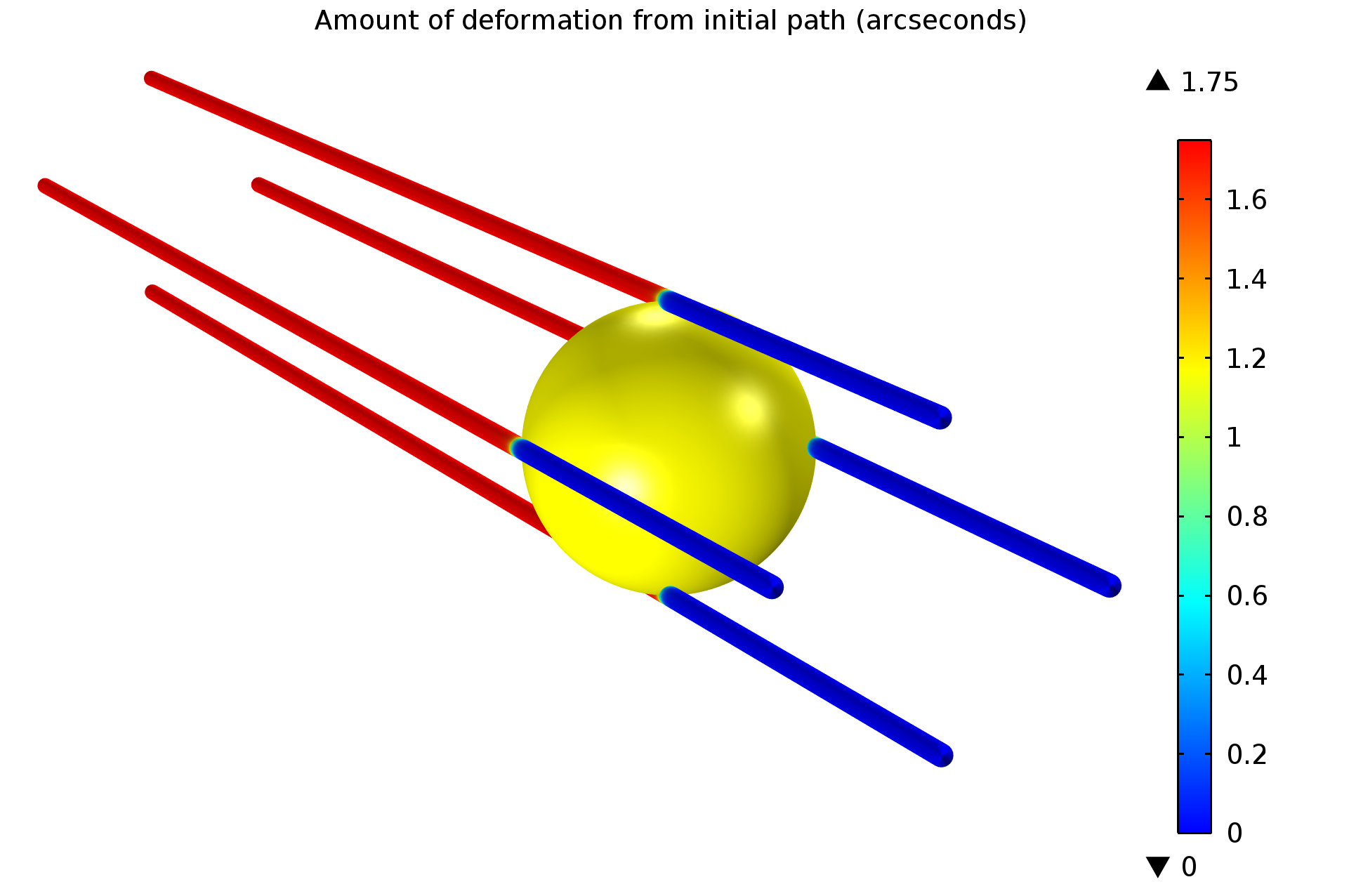
This model demonstrates how the sun causes 1.75 arcseconds of deflection for rays grazing the sun's surface as observed from the earth. Einstein predicted this value after refining his theory of relativity during World War I. Read More
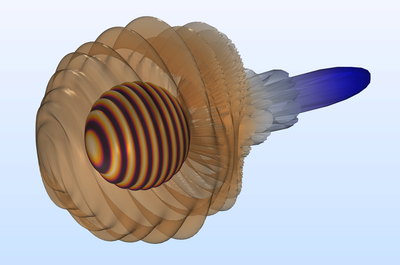
This example uses asymptotic techniques to study the radar cross-section (RCS) response of a conductive sphere. The selected physics interface transforms the incident plane-wave field on the boundaries to the far-field using the Stratton–Chu formula. The computed results are compared to ... Read More


