
The Application Gallery features COMSOL Multiphysics® tutorial and demo app files pertinent to the electrical, structural, acoustics, fluid, heat, and chemical disciplines. You can use these examples as a starting point for your own simulation work by downloading the tutorial model or demo app file and its accompanying instructions.
Search for tutorials and apps relevant to your area of expertise via the Quick Search feature. Note that many of the examples featured here can also be accessed via the Application Libraries that are built into the COMSOL Multiphysics® software and available from the File menu.
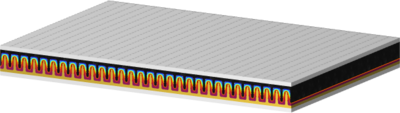
The miniaturization of electronics devices requires batteries with higher energy density and power. To increase the contact area between the electrodes and the solid electrolyte, 3D configurations such as the trench geometry are used. This example demonstrates how to model a solid-state ... Read More
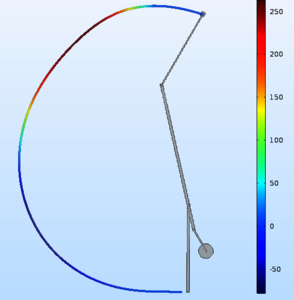
In this multibody dynamics model of a simple counterweight trebuchet, a parametric sweep is used to study throwing distance as function of the sling length. For more details on performing a multibody analysis of a counterweight trebuchet, see this blog post: What Is the Physics Behind a ... Read More
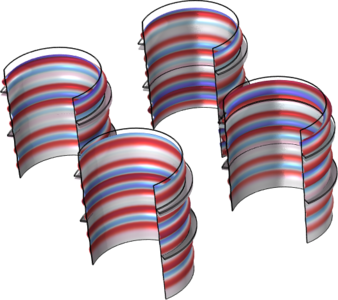
These models illustrate some important topics when modeling buckling imperfection. The Euler 2 Buckling Imperfection model shows a simple case with a cantilever beam buckling under compression. Three different buckling modes are combined as initial imperfections. The other model, ... Read More
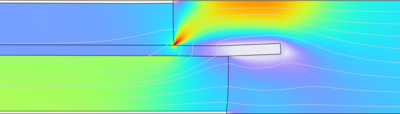
The electrodes of a lithium-ion battery are porous, consisting of an active solid material, a binder, and pores filled with liquid electrolyte. If a force is applied on the porous layers of a battery, this will affect the volume fraction of the electrolyte-filled pores in the electrodes, ... Read More

This model describes the corrosion of magnesium (Mg) alloys in physiological environments using a phase-field formulation. The approach couples Mg dissolution kinetics with ionic transport, enabling the transition from activation-controlled to diffusion-controlled regimes to be captured. ... Read More
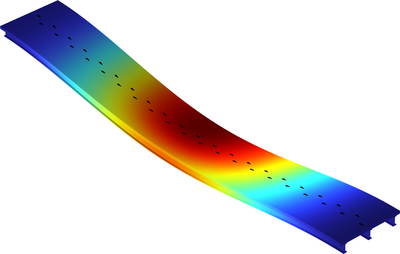
A highly simplified pedestrian bridge is for simplicity imagined to consists of a concrete slab on supported by three I-beams. The design is to be evaluated for peak acceleration due to walking. The model analyzes uncertainty in peak acceleration due to some material damping properties ... Read More
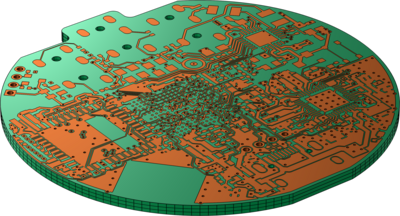
PCB is fabricated by laminating multiple materials, such as FR-4, copper, and resin, which exhibit significantly different coefficients of thermal expansion (CTE). When subjected to heating, the differential thermal expansion among these layers induces interlaminar deformation mismatch, ... Read More
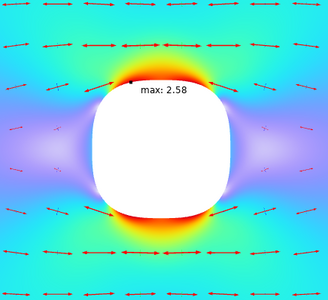
In this model, the stress concentrations around a superelliptic hole in a thin plate are investigated. To learn more about this model, see our accompanying blog post “Stress Concentrations Around a Superellipse”. Read More
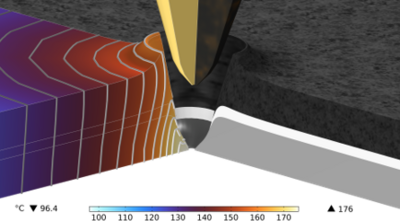
This model showcases a nail penetration experiment into a layered battery. It couples the Solid Mechanics, Lithium-Ion Battery, and Heat Transfer interfaces. A nail is punched into a sandwiched battery consisting of two electrodes and a separator. As soon as the nail connects both ... Read More

This is a demo model to show how to model connections in a mechanical system using Multibody Dynamics interface. In this model, pantograph mechanism is modeled. The purpose of this mechanism is to produce an identical, either enlarged or miniaturized, copy of an existing drawing. Read More


