
Explore the innovative ways multiphysics simulation is being used worldwide to advance research
Multiphysics modeling and simulation drives innovation across industries and academia — as is evidenced by the many uses showcased in the technical papers and posters presented by engineers, researchers, and scientists at the COMSOL Conference each year.
Draw inspiration from the recent proceedings collected below, or, to find a specific presentation or filter by application area or conference year/location, use the Quick Search tool.
View the COMSOL Conference 2025 Collection
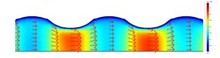
A finite element model is employed to describe the electric potential distribution and electroosmotic flow field inside a wavy cylindrical channel. The model uses coupled Laplace and Poisson-Boltzmann to evaluate the electric potential distribution inside the channel. It also contains ... Read More
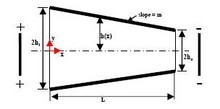
A fundamental understanding of the transport phenomena in microfluidic channels is critical for systematic design and precise control of such miniaturized devices towards the integration and automation of Lab-on- a-chip devices. Electroosmotic flow is widely used to transport and mix ... Read More

In this paper a finite element method(FEM) study of a surface acoustic wave (SAW)device excited by electrostatic coupling method is performed by using COMSOL Multiphysics. We have modeled a Rayleigh wave type SAW device by choosing YZ Lithium niobate as the substrate. The effect of ... Read More
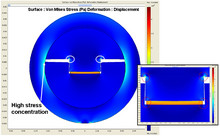
Optically addressable MEMS mirrors are required for future high density adaptive optics array systems. We have demonstrated a novel technique of achieving this by actuating low stress Silicon Nitride micro mirrors via cascaded wafer bonded Gallium Arsenide photo detectors on Gallium ... Read More
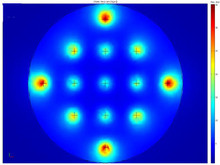
Carbon nanotubes (CNTs) have been proven experimentally to be well suited for field emission applications. An optimized triode configured CNT field emission array is developed using the COMSOL Multiphysics Electrostatics Application to adjust five key physical dimensions to investigate ... Read More

This paper presents a novel methodology towards the design, analysis, and the fabrication process involved in developing a cost effective method to create a piezoelectric actuator by means of the flexoelectric effect. The basic physical equations of the flexoelectric effect and the ... Read More

Surface acoustic wave gas sensors use a chemically sensitive resistive layer to detect gas concentration. The resistivity of the sensing material, the sensing layer thickness, and the spacer layer thickness all affect the surface wave propagation velocity. Existing analytic theory ... Read More
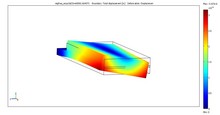
A 3D finite element model (FEM) of the PEMC sensor was developed to characterize the modes of vibration that have demonstrated high sensitivity to mass-change in experimentally fabricated sensors. The fundamental bending mode of vibration and the 1st bending harmonic are predicted at 10 ... Read More

COMSOL Multiphysics was used to solve a phonon Boltzmann transport equation (BTE) for nanoscale heat transport problems. One dimensional steady-state and transient BTE problems were successfully solved based on finite element and discrete ordinate methods for spatial and angular ... Read More
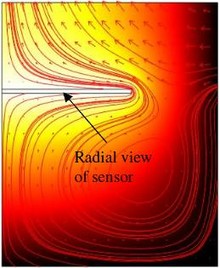
COMSOL Multiphysics is employed to model, simulate and predict the performance of a high Q, in-plane rotational resonating MEMS sensor. The resonating sensor disk is driven by thermal expansion and contraction of the support tethers due to AC joule heating. The resonant frequency is ... Read More


