
Explore the innovative ways multiphysics simulation is being used worldwide to advance research
Multiphysics modeling and simulation drives innovation across industries and academia — as is evidenced by the many uses showcased in the technical papers and posters presented by engineers, researchers, and scientists at the COMSOL Conference each year.
Draw inspiration from the recent proceedings collected below, or, to find a specific presentation or filter by application area or conference year/location, use the Quick Search tool.
View the COMSOL Conference 2025 Collection
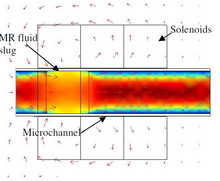
This paper presents the approach taken through the utilization of COMSOL Multiphysics 3.5a, to develop a model that simulates the flow of a magnetorheological (MR) fluid through a micro-channel. The model was developed as an aid in the analysis of a micropump that produces flow by means ... Read More

This paper presents an Analog to Digital Microfluidic Converter (ADMC) using passive valves and enabling the conversion of a continuous liquid flow into droplets for Electro-Wetting On Dielectric (EWOD) actuation. Valves calibration, geometry characteristics and losses reduction have ... Read More
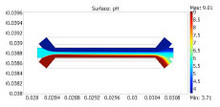
A portable device that can identify protein and peptides real time in complex biological systems such as human bodily fluids reliably and accurately is in high demand to properly diagnose and treat medical conditions. Lynntech has developed an innovative Polydimethylsiloxane (PDMS) based ... Read More

It is possible to control the motion of magnetic beads using a combination of hydrodynamic and electromagnetic forces. In this work, we investigate the possibility to manipulate the motion of beads with different magnetic moments in a special microfluidic structure so as to separate ... Read More
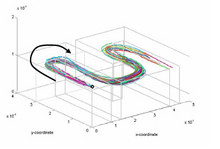
Convective transport of macromolecules or micro and nanoparticles in microsystems are usually predicted by solving the Navier Stokes equations for the carrier fluid and a concentration equation for the diffusing species. In the case of isolated particles or complicated geometries with ... Read More
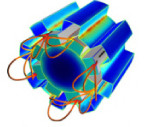
One challenge in designing micro-electromechanical systems (MEMS) is considering the variability of design parameters caused by manufacturing tolerances and material properties. The function of MEMSs is significantly influenced by this variability, which can be represented in terms of ... Read More

The mixing characteristics and residence time distributions (RTDs) of a staggered herringbone microchannel have been investigated numerically by COMSOL Multiphysics and by particle tracking algorithms that incorporate diffusion via a random walk. All simulations were validated with ... Read More

This paper presents a 3D finite element model in COMSOL for the electro-thermal analysis of high power light emitting diodes (LEDs). The proposed model and implementation approach require basic electrical and optical parameters that may be experimentally derived with the aid of advanced ... Read More

A micromirror or a torsional actuator in general has been proven to be one of the most popular actuators fabricated by Micro-Electro-Mechanical System (MEMS) technology in many industrial and biomedical applications such as RF switches, a laser scanning display, an optical switch matrix, ... Read More
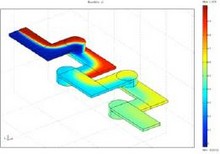
The mixing of liquids was characterized in thirteen different microfluidic devices. The goal was to characterize, in a uniform manner, the flow and mixing that occurred in slow, laminar flow and to present the results that allow quick designs. The mixing of a dilute chemical in another ... Read More


