
See How Modeling and Simulation Is Used Across Industries
Multiphysics modeling and simulation drives innovation across industries and academia — as is evidenced by the many uses showcased in the technical papers and posters presented by engineers, researchers, and scientists at the COMSOL Conference each year.
Draw inspiration from the recent proceedings collected below, or, to find a specific presentation or filter by application area or conference year/location, use the Quick Search tool.
View the COMSOL Conference 2025 Collection
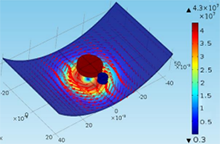
A pulsed Eddy Current (EC) probe, using the transient response to a stepped voltage is being developed for in-reactor inspection of CANDU® fuel channels. Pulsed EC has the advantage of generating a spectrum of discrete frequencies, allowing the simultaneous collection of data from a ... Read More

Solar energy storage has been an extensive research topic among the several thermal energy applications over the past three decades. Thermal energy storage (TES) systems in general, improve the energy efficiency of systems and sustainability of buildings by reducing the mismatch between ... Read More

The multiphysics simulation package COMSOL was incorporated into a course in mathematical modeling for chemical engineers. Our implementation for the first year of using COMSOL in the course is described, and assessment results based on examinations and student survey results are ... Read More
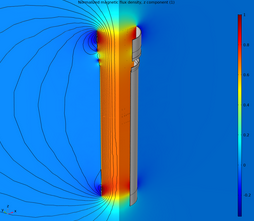
The vacuum arc remelting is a refining process used to melt reactive metals like titanium, zirconium or hafnium. Melting is performed under vacuum to avoid reactions between liquid metal and oxygen which could be a source of pollution. This process is particularly well suited to purify ... Read More
Recently, due to the dynamically increasing complexity of modern systems, a strong necessity appears for more systematic approaches to high quality control and process monitoring. Requirements imposed by process control in the area of spatio-temporal physical systems also called ... Read More

In order to qualify experiments for in-vessel irradiation at the High Flux Isotope Reactor (HFIR) at Oak Ridge National Laboratory, safety assessments need to be completed and documented to ensure adequate target cooling and structural integrity. Previously, finite element analysis ... Read More

Even though sonochemical reactors have been studied extensively for decades, there is limited data on their characterization when the volume of the sample is fixed. The Acoustics Module and COMSOL Multiphysics® software are used to resolve the pressure field. The validated numerical ... Read More
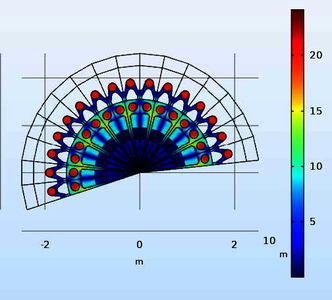
高温气冷堆中使用了大量的碳素材料,作为多孔材料,碳素材料含有一定水分等杂质。为了减小反应堆高温运行条件下的堆内材料腐蚀,高温堆在初装堆和事故后需要对一回路进行严格的加热除湿操作。目前一回路加热除湿主要是依靠主氦风机旋转,将动能转换为热能来提升温度。本文将采取另外一种方案,在蒸汽发生器处增加外加热源来加热一回路工质。基于大型商用软件COMSOL Multiphysics建立高温堆内一回路加热的流动传热模型,对两种加热方案的一回路升温过程作数值分析,为高温堆加热除湿方案的选择提供有益的指导。本文中使用的物理场为传热——共轭传热——湍流,多物理场耦合为非等温流动。 Read More

Thrombosis is the formation of a thrombus or blood clot within a vessel to maintain the integrity of the circulatory system [1]. The process involves surface interactions, with coagulation leading to the formation of thrombin and a fibrin network, and platelet aggregation [2]. ... Read More
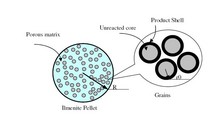
A novel mechanism for the carbothermal reduction of Ilmenite is proposed and validated with the help of a comprehensive mathematical model. A time-dependent isothermal pellet-grain model is used to simulate the kinetic behaviour of a spherical pellet of ilmenite (FeTiO3) in CO/CO2 ... Read More


