
See How Modeling and Simulation Is Used Across Industries
Multiphysics modeling and simulation drives innovation across industries and academia — as is evidenced by the many uses showcased in the technical papers and posters presented by engineers, researchers, and scientists at the COMSOL Conference each year.
Draw inspiration from the recent proceedings collected below, or, to find a specific presentation or filter by application area or conference year/location, use the Quick Search tool.
View the COMSOL Conference 2025 Collection
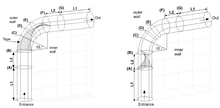
Non-Newtonian laminar flows in curved circular tubes with inserts are investigated by computer simulations. 0.65% solution of NaCMC is considered. Three-dimensional incompressible Navier-Stokes equations are solved using COMSOL Multiphysics. Placements of inserts inside the curved tubes ... Read More
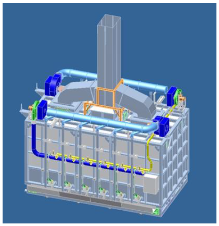
This paper deals with an integrated numerical and experimental analysis work aiming at the investigation of the thermal distribution inside an industrial furnace built for metal materials treatments. The main goal of the research is to find the geometrical and/or functional parameters ... Read More
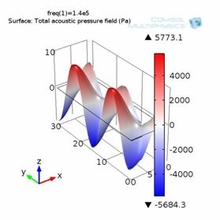
This paper describes the design of an ultrasonic transducer using different lead free piezo-electric materials and evaluates their performance with different glucose levels in the human blood. COMSOL Multiphysics 4.2a was used for the simulation study using 2D axis symmetric model of ... Read More

We treat a gradient constrained minimization problem which has applications in mechanics and superconductivity. A particular case of this problem is the elastoplastic torsion problem. In order to solve the problem we developed an algorithm in an infinite dimensional space framework ... Read More
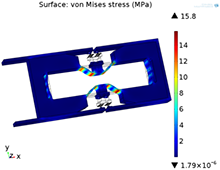
A research team at FSU CAPS is developing a novel fast disconnect switch based on a piezoelectric actuator for use in next-gen electric power distribution systems. COMSOL Multiphysics® software was used to optimize geometry and material selection of the disconnect switch. Current ... Read More
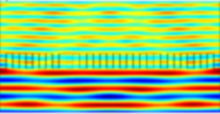
Ultrasonic acoustic waves usually encounter interfaces with significant impedance mismatch in practical medical or industrial imaging applications. A transparent interface can help to improve the performance of medical and industrial imaging and overall innovative applications. ... Read More
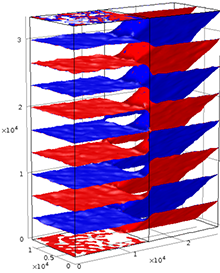
Cu-Nb multilayer nanocomposite has prospective applications in nuclear industry because of its ability to self-heal from radiation damage. The goal of the study is to find a suitable joining method for the composite to produce industrial-scale pieces, free of defects threatening the ... Read More
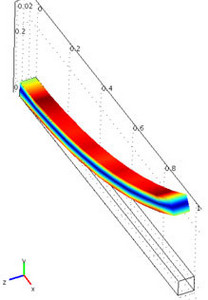
In this work the solution of the structural problem obtained by mean of the velocity approach is presented. More in detail the balance and constitutive equations are expressed in Eulerian form, the mesh is not material. The approach is general, is suitable both for material boundary or ... Read More

Pore-scale modeling of multiphase flow through porous media is addressed most frequently to improve our understanding of flow and transport phenomena in such settings. It can be used to obtain macro-scale constitutive equations, to assign multiphase flow properties in large scale models, ... Read More

The Helmholtz Coil generates a uniform magnetic field. The commercially available large-size Helmholtz coils prove to be very expensive. This paper describes the economical method of designing and construction of a Helmholtz coil. COMSOL Multiphysics AC/DC Module simulated results and ... Read More


