
See How Modeling and Simulation Is Used Across Industries
Multiphysics modeling and simulation drives innovation across industries and academia — as is evidenced by the many uses showcased in the technical papers and posters presented by engineers, researchers, and scientists at the COMSOL Conference each year.
Draw inspiration from the recent proceedings collected below, or, to find a specific presentation or filter by application area or conference year/location, use the Quick Search tool.
View the COMSOL Conference 2025 Collection
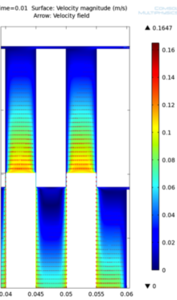
The current work is dedicated to develop a FEM model for compressors using moving mesh. An analytical model is already developed for a classic compressor based on mass and energy balance and is extended to a finned piston compressor. COMSOL Multiphysics® is employed to verify the ... Read More
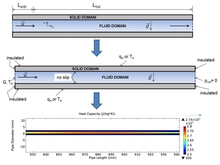
In clean coal technologies, improving energy conversion efficiency is one of the most important directions. Compared to traditional subcritical power plants, pressure-increased supercritical power plants improve the plant energy efficiency from 35% up to 45%. This work presents a study ... Read More

This paper highlights the use of the COMSOL Multiphysics® software during the design process of a thermal cycling system for regulated PCM phase transitioning. The primary purpose of the simulations was to predict the system behavior in response to an ON/OFF temperature control system ... Read More

In general battery cells are charged/discharged using constant current or constant power expressed as C-Rates and P-Rates respectively. We are developing a single cell-level Li-Ion battery model in order to simulate the performance and the physicochemical phenomena under power ... Read More

This work is to present an implementation of COMSOL with MATLAB® [1] for the liquid cooling system of a battery pack based on the physics in COMSOL. The m.file of a model of battery module from COMSOL 4.2 is exported and modified to run in MATLAB®, as well as is managed by using another ... Read More
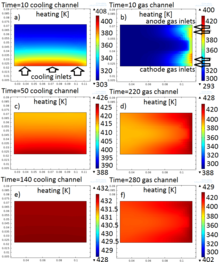
HTPEM fuel cells are considered to be the next generation fuel cells. The electrochemical kinetics for electrode reactions are enhanced by using PBI membrane at an operation temperature between 160-180 °C comparing to LTPEM fuel cells. But starting HTPEM fuel cells from room temperature ... Read More
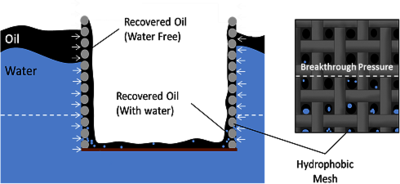
Hydrophobic meshes are a new, promising technique for the recovery of spilled oil in the ocean. They allow to recover and store oil, while filtering it from the surrounding water. They are clean, efficient and can be used in continuously. These meshes have one drawback, however: if they ... Read More
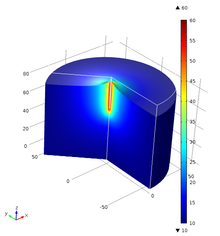
Energy piles, i.e. heat exchangers located within the foundation piles of buildings, are used for heating of cooling purposes. Although the absolute values of deformations and temperature gradients are low or moderate, the entire setting can be influenced by thermo-hydro-mechanical ... Read More
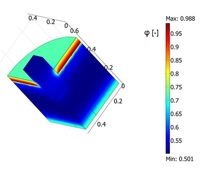
The simulation of heat and moisture transfer represents an essential resource in designing energy efficient buildings. In this paper a time-dependent wall model, consisting of several homogeneous domains, with third-type boundary conditions imposed on the surfaces, is implemented in the ... Read More
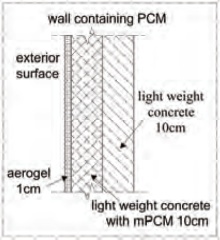
Simulation tools for building physics problems play an important role in design and understanding the behavior of energy efficient buildings. There are different tools available for simulation of these problems, but each simulation tool has its own advantages and limitations. In this ... Read More